[Fractal Sprint – Live Webinar | March 24] Beyond the Portal: Building a Governed Internal Developer Platform | Register now →

Blog
From Weeks to Minutes: Combining Speed and Governance in Cloud Environments with Fractal Cloud

From Weeks to Minutes: Combining Speed and Governance in Cloud Environments with Fractal Cloud

Introduction

The cloud promised instant scale, yet in many enterprise organizations, developers still wait days or even weeks for a new environment to be provisioned. The bottleneck is rarely technical; modern cloud providers have made resource allocation virtually instantaneous. What truly slows organizations down is the bureaucratic labyrinth of governance.Production environments must rigidly comply with security policies, architectural standards, observability requirements, and cost controls. Ensuring all these constraints are respected typically forces a slow-motion negotiation between infrastructure operators, platform engineering teams, and application developers. Without a unifying abstraction layer, every single deployment becomes a painful compromise between development speed and operational control.Fractal Cloud was engineered to obliterate this tradeoff. As a premier Internal Developer Platform (IDP), it delivers secure, universally compliant infrastructure across any cloud provider, setting a new standard for platform engineering. By equipping teams with ready-to-use building blocks that natively combine vendor-specific knowledge with security best practices, Fractal Cloud unlocks a frictionless developer experience. Organizations can finally transition from manual, ticket-based provisioning to a governed self-service model where fully compliant infrastructure is instantiated in minutes.Crucially, this frictionless experience does not force engineers to change how they work; it meets them where they are. While code-first developers can leverage a powerful SDK, the Internal Developer Platform also features an intuitive, elegantly designed Web interface to manage the entire resource lifecycle visually. Teams can visually browse a catalog of available building blocks, launch new environments, and manage running systems through guided workflows without writing a single line of code. Regardless of the interaction model chosen Web UI or SDK, both paths are strictly governed by the exact same architectural rules and abstractions.

The Real Problem: Governance Cannot Live in Scripts

Historically, organizations have attempted to enforce infrastructure standardization through Infrastructure as Code (IaC) repositories. But while IaC is excellent at automating raw provisioning, it is fundamentally ill-equipped to solve the governance problem.Scripts drift. Standards evolve. Teams inevitably fork templates to bypass bottlenecks. Over time, governance fragments across disjointed codebases, static documentation pages, and fragile operational procedures. The resulting landscape is frustratingly predictable: architectural patterns silently diverge, compliance audits become archaeological expeditions, and platform teams lose critical visibility into their own deployed systems.Fractal Cloud approaches this challenge from an entirely different angle. Instead of treating infrastructure definitions as a collection of brittle scripts, it elevates them to governed architectural components. This philosophy is rooted in "Fractal Architecture," where reusable infrastructure constructs are designed to seamlessly encapsulate both industry best practices and operational lifecycle logic.

Fractals and Live Systems

At the very core of this platform beats the concept of the "Fractal." A Fractal is a reusable, strictly governed, cloud-agnostic construct.When an application team instantiates a Fractal, it transforms into a "Live System." This Live System represents the tangible, running infrastructure deployed in a specific environment, continuously bound and monitored by platform policies. This distinction between definition and execution is the secret to scaling operations: platform teams define the Fractals once, and application teams instantiate them thousands of times. The result is a standardized architecture that accelerates, rather than stifles, the development lifecycle.

A Platform Engineered Around Human Roles

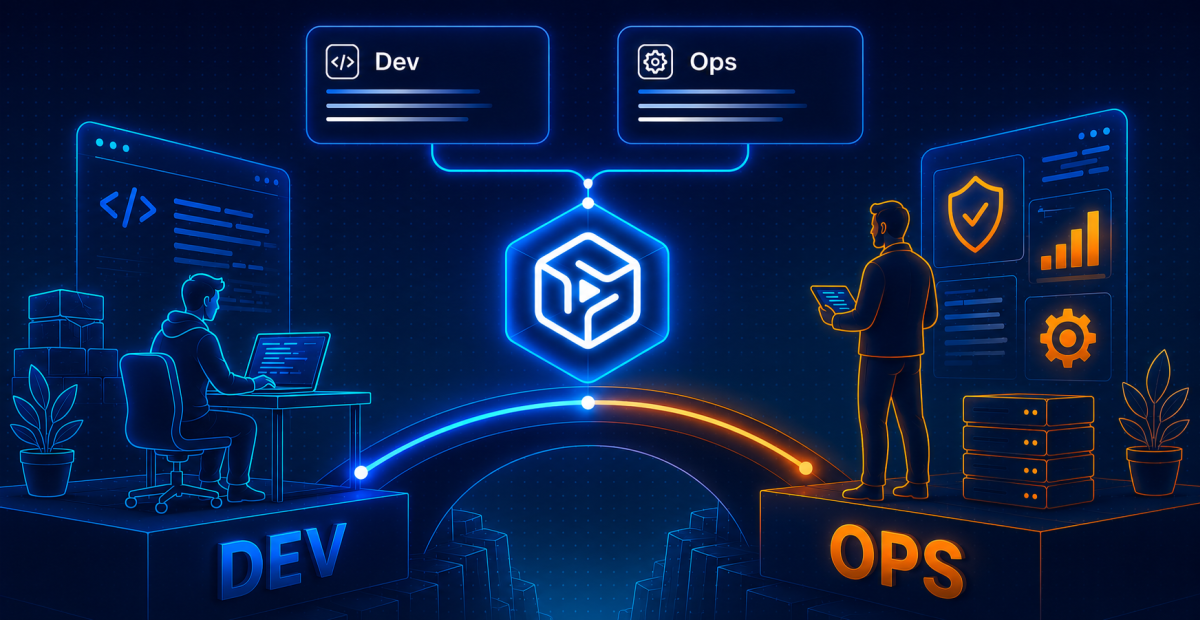
One of the most compelling strengths of Fractal Cloud is how naturally it maps to the real-world responsibilities of modern engineering teams. It introduces a layered ownership model that eliminates friction by allowing each group to focus exclusively on their domain of expertise.(Note: While the examples below showcase the SDK, every configuration step and deployment is equally achievable via the visual Web interface).The journey begins with Infrastructure and Operations teams, who define the foundational bedrock of the environment.At this layer, operators establish the absolute governance boundaries of the system. They configure environment ownership, cloud project guardrails, and organizational identifiers, ensuring that every system born within the platform is inextricably linked to its correct operational and billing context.Building upon this foundation, Platform Engineering teams design the reusable capabilities that define the organization's technical standard.Consider the deployment of a container platform built on Kubernetes. The platform team configures the complex infrastructure details like region settings, node pools, and machine types and more, encoding deep architectural standards into simple, consumable assets. Application teams can then leverage these capabilities without ever needing to decipher low-level cloud configurations.Finally, this layered approach culminates in a pristine developer experience. Application Developers are freed to focus entirely on describing the workloads that drive business value.Instead of writing custom infrastructure scripts from scratch, developers define their workloads using high-level platform abstractions. They simply reference their application repositories, deployment branches, and runtime variables, confidently relying on the platform to translate these requests into secure, running infrastructure.

Composing Systems Instead of Writing Code

Once the foundational components and application workloads are defined, they are elegantly woven together.A Live System acts as the ultimate representation of an application’s running architecture. It physically and logically connects platform capabilities, developer workloads, and foundational infrastructure into a single, cohesive object. This composition model ensures that the entire infrastructure stack remains infinitely traceable, auditable, and lifecycle-aware.The culmination of this process is handled by the Fractal Automation Engine.Rather than executing a fragile daisy-chain of provisioning scripts, Fractal Cloud delegates the heavy lifting to this intelligent engine. It rigorously validates the system definition, provisions the requisite infrastructure, and enforces configuration consistency across the board. Because the engine operates on semantic platform abstractions rather than raw, vendor-specific APIs, organizations achieve airtight automation without sacrificing an ounce of governance.

A Shift in How Infrastructure is Delivered

The key innovation of Fractal Cloud isn't merely provisioning speed, public cloud providers solved that a decade ago. The true breakthrough is the paradigm shift of an Internal Developer Platform that moves governance out of human bottlenecks and bakes it directly into the architecture.By empowering platform teams to encode their expertise into Fractals, developers are granted the autonomy to consume complex capabilities safely and independently. Meanwhile, operations teams retain absolute visibility and lifecycle control over every deployed asset. With Fractal Cloud, speed and governance are no longer opposing forces; they are the synchronized engines of modern enterprise agility.

Cut the Wait. Reduce the Cost.
Keep Control.

More articles

From Weeks to Minutes: Combining Speed and Governance in Cloud Environments with Fractal Cloud

From Weeks to Minutes: Combining Speed and Governance in Cloud Environments with Fractal Cloud

The cloud promised instant scale, yet in many enterprise organizations, developers still wait days or even weeks for a new environment to be provisioned. The bottleneck is rarely technical; modern cloud providers have made resource allocation virtually instantaneous. What truly slows organizations down is the bureaucratic labyrinth of governance.Production environments must rigidly comply with security policies, architectural standards, observability requirements, and cost controls. Ensuring all these constraints are respected typically forces a slow-motion negotiation between infrastructure operators, platform engineering teams, and application developers. Without a unifying abstraction layer, every single deployment becomes a painful compromise between development speed and operational control.Fractal Cloud was engineered to obliterate this tradeoff. As a premier Internal Developer Platform (IDP), it delivers secure, universally compliant infrastructure across any cloud provider, setting a new standard for platform engineering. By equipping teams with ready-to-use building blocks that natively combine vendor-specific knowledge with security best practices, Fractal Cloud unlocks a frictionless developer experience. Organizations can finally transition from manual, ticket-based provisioning to a governed self-service model where fully compliant infrastructure is instantiated in minutes.Crucially, this frictionless experience does not force engineers to change how they work; it meets them where they are. While code-first developers can leverage a powerful SDK, the Internal Developer Platform also features an intuitive, elegantly designed Web interface to manage the entire resource lifecycle visually. Teams can visually browse a catalog of available building blocks, launch new environments, and manage running systems through guided workflows without writing a single line of code. Regardless of the interaction model chosen Web UI or SDK, both paths are strictly governed by the exact same architectural rules and abstractions.

Platform Engineering 2026: Beyond the Portal, Toward the Invisible Control Plane

Platform Engineering 2026: Beyond the Portal, Toward the Invisible Control Plane

Looking back at 2024, we remember the obsession with "UI-first thinking." At the time, many companies fell into the trap of confusing the interface with the platform, spending months implementing developer portals (like Backstage) without first resolving the underlying fragmentation.It is precisely to overcome this confusion between interface and platform that solutions like Fractal Cloud are born as a control plane first, rather than just a visible product. Today, in 2026, we know that the portal is just a view, not the substance.Platform Engineering has matured, transforming from the management of integrated toolchains into a product discipline. The Internal Platform is no longer an agglomeration of scripts and services, but a proper product with a roadmap, stable APIs, clear ownership, and a governed lifecycle.In Fractal Cloud, the platform is a governed product: every exposed capability is deliberately limited, versioned, and traceable.The driver for this evolution was the need to manage a level of complexity that is no longer compressible by humans alone. Between provider fragmentation, AI costs, and supply chain security, the cognitive load on the individual developer became unsustainable. In 2026, the Platform does not serve to "facilitate" via graphical interfaces; it serves to ensure determinism.Here is how the discipline has evolved and why the Internal Developer Platform (IDP) of the future is, first and foremost, an operating model.

Architecture diagram showing Fractal Cloud enabling cloud sovereignty by controlling data, applications, and operational processes without vendor dependency

Absolute Autonomy: Why Cloud Sovereignty Allows No "Grey Areas"

In the debate over IT modernization, a comfortable yet dangerous narrative has taken hold: the idea that cloud sovereignty is a spectrum, a scale of greys where "a little compliance" is still a step in the right direction.