[On-Demand – Webinar] Fractal Sprint on Digital Sovereignty | Watch now →

Blog
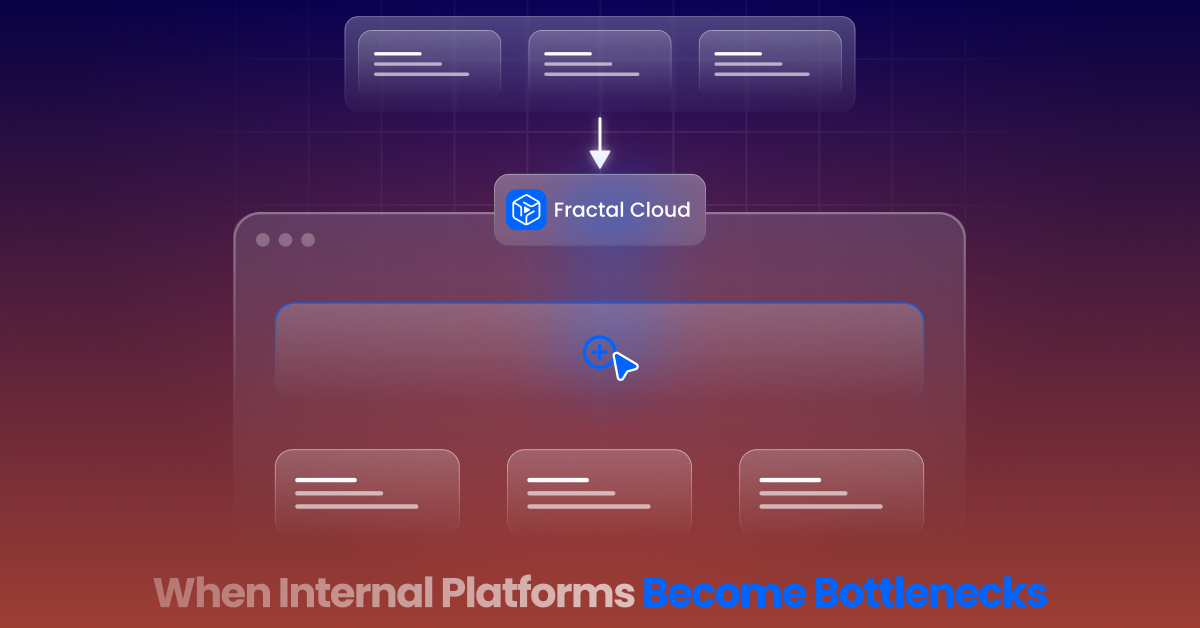
Illustration of Fractal Cloud orchestrating infrastructure components, highlighting how internal platforms can become bottlenecks

When Internal Platforms Become Bottlenecks

Introduction

Over the last decade, many organizations have embraced Platform Engineering as a way to accelerate software delivery.The promise is compelling: build an internal platform that provides developers with standardized tools, infrastructure, and automation so they can focus on building applications instead of managing environments.In theory, this should increase productivity, improve governance, and reduce operational overhead.In practice, things are often more complicated.

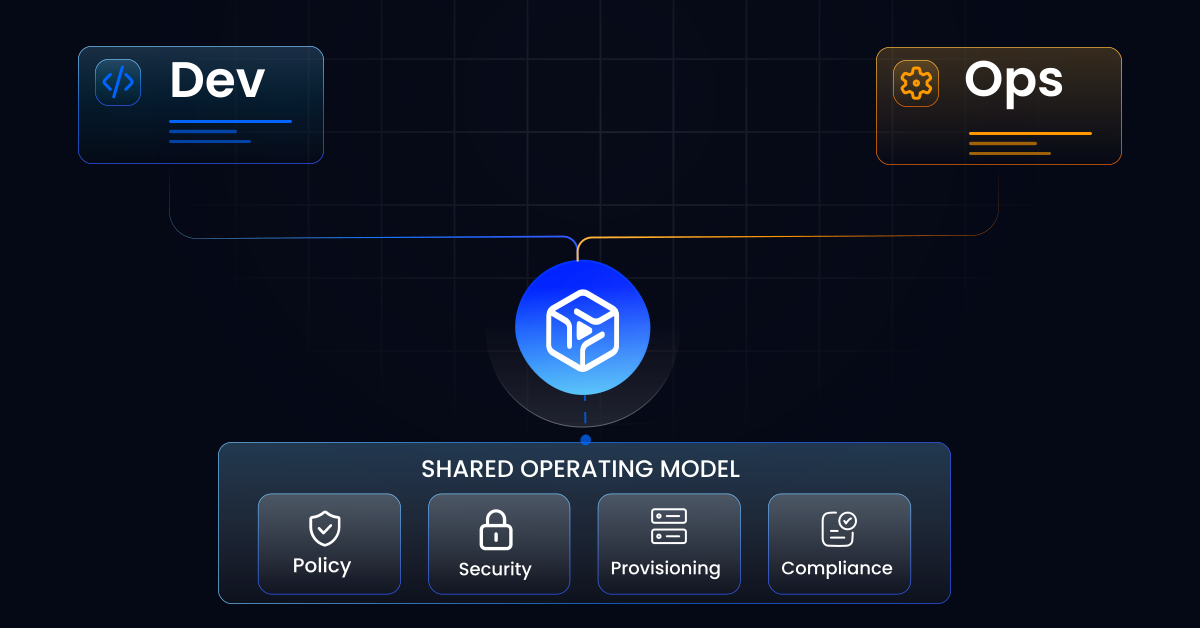
Early in my career, I witnessed an example that still shapes how I think about platforms today.A large enterprise wanted to accelerate the development of its digital services while keeping infrastructure under control. Their solution was ambitious: build an internal development platform designed specifically for web applications.The goal was clear.The platform would unify development environments, standardize architecture patterns, and allow backend developers to deliver full web experiences without requiring deep frontend specialization.At first, the initiative made perfect sense. The organization wanted to:🔷 unify customer-facing web applications🔷 eliminate dependency on specialized development tooling🔷 reduce licensing costs for commercial IDEs🔷 replace an aging content management systemThe platform team built both an integrated development environment and a runtime platform. Developers were expected to adopt it as the standard way to build and deploy applications.Initially, the initiative looked promising.But as the platform evolved, its complexity grew in unexpected ways.Within three years, the platform team had expanded to more than one hundred developers. Each new use case required additional features, integrations, and support mechanisms.What started as a productivity tool gradually became a large product of its own.At the same time, onboarding new developers became increasingly difficult. Engineers joining the company had to learn custom tools and workflows that existed nowhere outside that specific platform.Meanwhile, real-world applications rarely fit perfectly into predefined patterns.Development teams began introducing external frameworks and tools to fill the gaps.Exceptions multiplied.Standardization started to erode.And the legacy system that the platform was supposed to replace continued to exist alongside it.Instead of simplifying the architecture, the organization ended up maintaining two systems.This is a common anti-pattern in platform engineering.The problem was not the decision to build a platform.The problem was how the platform handled complexity.Many internal platforms try to hide infrastructure complexity behind rigid frameworks or proprietary tools. That approach can simplify a narrow set of use cases, but it often introduces friction when teams need flexibility.Modern software systems are inherently complex.Distributed architectures, cloud infrastructure, observability, security policies, and compliance requirements all introduce layers of operational responsibility.Trying to eliminate that complexity entirely is unrealistic.Platforms fail when they try to hide complexity.They succeed when they organize it.Infrastructure specialists possess deep knowledge about scalability, reliability, security, and cloud provider capabilities. The role of a platform is not to replace that expertise, but to translate it into reusable architectural building blocks.Those building blocks should embed best practices while remaining composable and adaptable.In other words, a platform should act as an interface between specialized infrastructure knowledge and application development.This challenge becomes even more visible in cloud-native environments.Over the years, organizations have adopted a wide range of automation tools and Infrastructure as Code solutions. These tools help standardize provisioning, but they often introduce another problem: the proliferation of scripts, templates, and configurations that must be maintained over time.Different teams solve the same infrastructure problems independently. Automation logic gets duplicated across repositories. Governance and security checks are implemented inconsistently.What starts as automation quickly turns into a fragmented ecosystem of scripts and pipelines.The real challenge is not simply automating infrastructure.It is designing a platform model where infrastructure capabilities are reusable, governed, and evolvable over time.This is the design principle behind what we call Fractal Architecture.In this model, infrastructure capabilities are encapsulated into reusable constructs called Fractals. Each fractal represents a governed architecture pattern composed of infrastructure components, connectivity rules, and operational policies.Instead of writing infrastructure definitions from scratch, platform teams define these patterns once and publish them as reusable building blocks.Developers interact with these constructs through clear interfaces, instantiating them to create real environments. Each instantiated environment becomes what we call a Live System: a running infrastructure instance that remains continuously aligned with the platform’s policies and lifecycle management processes.Behind the scenes, an automation layer orchestrates provisioning, updates, and governance consistently across environments.The goal is not to remove control from platform teams or autonomy from developers.The goal is to align them.Platform teams define and maintain architecture patterns. Development teams consume them as reliable infrastructure capabilities.When platforms are designed around reusable architectural patterns rather than rigid frameworks, they become significantly easier to evolve.New capabilities can be introduced by publishing new patterns rather than rewriting tooling. Operational policies can be enforced consistently across all environments instantiated from the same architecture.Most importantly, developers retain the ability to compose systems using reliable building blocks without becoming experts in every underlying technology.Platform Engineering has the potential to dramatically improve how organizations build and operate software.But achieving that outcome requires careful architectural thinking.A platform should not attempt to eliminate complexity.It should organize complexity into reusable structures that allow teams to move faster without compromising reliability or governance.The most effective platforms do not hide infrastructure.They transform infrastructure into reusable architecture.To explore the model and its architectural principles in more detail, read the full article on Fractal Architecture.Build Faster, Run Anywhere.

Cut the Wait. Reduce the Cost.Keep Control.

More articles

Illustration of Fractal Cloud orchestrating infrastructure components, highlighting how internal platforms can become bottlenecks

When Internal Platforms Become Bottlenecks

Over the last decade, many organizations have embraced Platform Engineering as a way to accelerate software delivery.The promise is compelling: build an internal platform that provides developers with standardized tools, infrastructure, and automation so they can focus on building applications instead of managing environments.In theory, this should increase productivity, improve governance, and reduce operational overhead.In practice, things are often more complicated.

Simplifying NIS2 compliance in multi-cloud environments through standardized infrastructure and automation

NIS2 and Cloud: how to simplify compliance without slowing down development

🔹 Executive takeawayNIS2 compliance is a matter of operational scale, not just regulation.Manual approaches are not sustainable in multi-cloud environments.Standardizing infrastructure is the most effective way to reduce risk and complexity.Embedding compliance into the platform allows you to accelerate without losing control.The NIS2 directive introduces new cybersecurity requirements for European organizations.The problem in 2026 is not understanding them.It’s implementing them in complex cloud environments without increasing operational complexity or slowing down development.Fractal Cloud addresses this challenge by integrating security, governance, and automation directly into the infrastructure.

Fractal Cloud Security by Design with built-in compliance in every Fractal

Security by Design: How Every Fractal Comes With Compliance Built In

There's a pattern in engineering organizations that have grown fast. Security works like this: developers provision infrastructure, then a security review happens, then issues get filed, then someone fixes them, then another review. The loop takes days. Sometimes weeks.This isn't security. It's security theater with a delayed blast radius.The deeper problem: when security lives in the process around infrastructure, it can't keep pace with the infrastructure itself. Every new team, every new cloud account, every new environment is another opportunity for the process to break down.This post is for platform teams and DevOps engineers who are tired of security being a bottleneck rather than a baseline. We'll cover why bolt-on security doesn't scale, what "security by design" means at the infrastructure level, and how Fractal Cloud implements it.