[Fractal Sprint – Live Webinar | March 24] Beyond the Portal: Building a Governed Internal Developer Platform | Register now →

Blog
Platform Engineering 2026: Beyond the Portal, Toward the Invisible Control Plane

Platform Engineering 2026: Beyond the Portal, Toward the Invisible Control Plane

Introduction

Looking back at 2024, we remember the obsession with "UI-first thinking." At the time, many companies fell into the trap of confusing the interface with the platform, spending months implementing developer portals (like Backstage) without first resolving the underlying fragmentation.It is precisely to overcome this confusion between interface and platform that solutions like Fractal Cloud are born as a control plane first, rather than just a visible product. Today, in 2026, we know that the portal is just a view, not the substance.Platform Engineering has matured, transforming from the management of integrated toolchains into a product discipline. The Internal Platform is no longer an agglomeration of scripts and services, but a proper product with a roadmap, stable APIs, clear ownership, and a governed lifecycle.In Fractal Cloud, the platform is a governed product: every exposed capability is deliberately limited, versioned, and traceable.The driver for this evolution was the need to manage a level of complexity that is no longer compressible by humans alone. Between provider fragmentation, AI costs, and supply chain security, the cognitive load on the individual developer became unsustainable. In 2026, the Platform does not serve to "facilitate" via graphical interfaces; it serves to ensure determinism.Here is how the discipline has evolved and why the Internal Developer Platform (IDP) of the future is, first and foremost, an operating model.

From "Golden Path" to Constrained (and Governed) Freedom

Until a few years ago, we talked about "Golden Paths": recommended routes that a developer could choose to follow. In 2026, this optional approach no longer scales in the face of increasingly stringent regulatory and operational constraints.The modern platform introduces the concept of "Constrained Freedom". It is not a cage that prevents movement, but a system of invisible rails. The developer defines the intent ("I need a database for transactional data"), and the platform handles translating it into infrastructure that complies with corporate standards.In Fractal Cloud, this constrained freedom is expressed through explicit interfaces: the developer cannot do "just anything," but only what the Blueprint exposes as a legitimate operation.This "invisibility" is not magic: it is determinism.🔷 There are no manual or "flaky" configurations.🔷 The platform does not generate simple configuration files but produces a governed and immutable infrastructure representation. Every instantiation generates a concrete, traceable system governed over time, not an ephemeral provisioning artifact.In platforms like Fractal Cloud, this determinism stems from versioned Blueprints that define not only what is created but also which operations are allowed over time. For the developer, complexity disappears. For those governing (CTO, CISO), the platform offers total visibility and portability: standards are coded into the product, not hardwired into the hardware.A Fractal defines the governed structure of infrastructure before any resource is created.

The Independent Control Plane (Governance Layer)

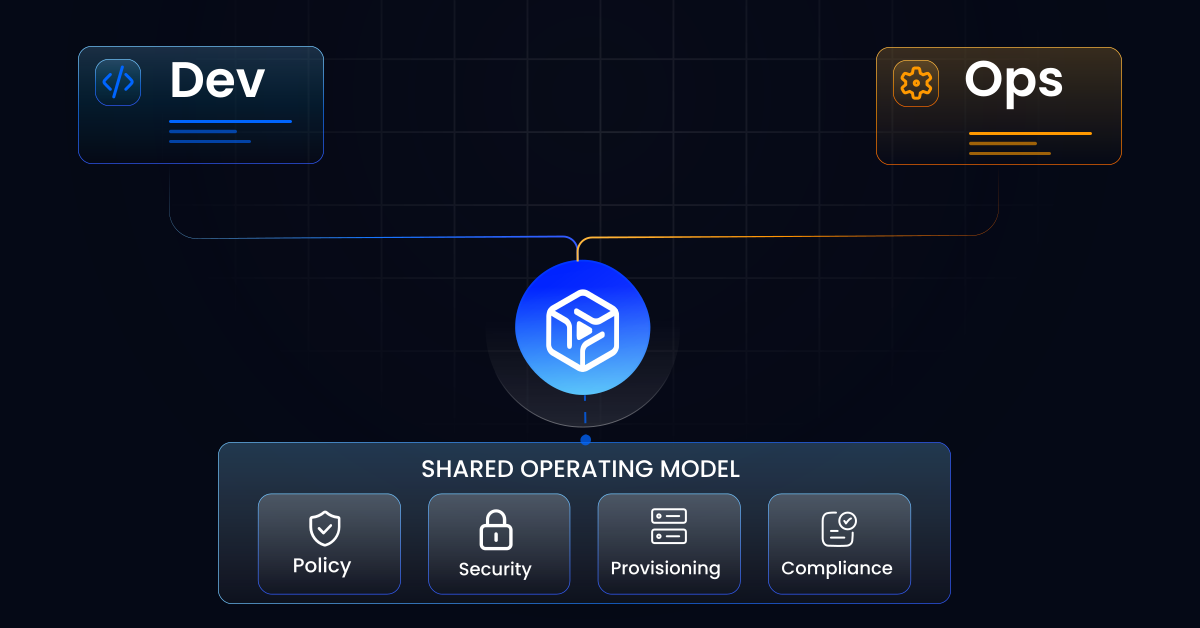
This is the deepest architectural shift. In 2024, infrastructure management was often bound to the specifics of a single provider. In 2026, we have understood that governance resides in the Control Plane.The Platform acts as an Independent Control Plane, sharply separating the control plane (who decides, who holds the policies, who holds the identity) from the execution plane (the underlying infrastructure, be it public cloud, on-premise, or edge).For example, in Fractal Cloud, this role is played by an Automation Engine that governs the entire lifecycle, independently of the underlying cloud.Live System Configuration: after selecting the Resource Group, a Fractal, and an Environment to deploy the infrastructure.The Platform Team does not write automation to create resources. It designs Blueprints where security, compliance, and performance standards are not applied "after" or "on top," but are embedded in the very definition of the system. In Fractal Cloud, Blueprints are not static templates but operating models that continue to govern the system even after provisioning.Any defined resource (whether an ephemeral development environment or a critical database) is born already with the correct configuration, security, and compliance levels for its purpose. It cannot be instantiated outside the rails established by the operating model, regardless of the underlying cloud.The platform becomes the single source of truth, making the base infrastructure (commodity) interchangeable based on current needs.

From Generic Automation to Intent-Based Operations

The idea that a developer must open a ticket (TicketOps) is obsolete not because "we are agile," but because un-coded operations no longer exist. In Fractal Cloud, if an operation requires a ticket, it means it should not exist.The dominant interface of Platform Engineering in 2026 is based on Intents. AI (or any advanced interface) is not an "autopilot" that performs magic, but a facilitator that navigates within boundaries predefined by the Platform Engineer.The typical scenario: The developer expresses a need: "I need a persistent cache for this service."The process is not "magical" but structured to guarantee autonomy and control:1. Blueprint Selection: The developer navigates the catalog and chooses the Blueprint (operating model) best suited to satisfy their intent.2. Capability Verification: They evaluate that the model offers the necessary functionalities, with the guarantee that compliance is already defined and embedded in the Blueprint itself.3. Instantiation: It is the user who instantiates the resource, executing the immutable code defined in the model without manual configurations.In platforms like Fractal Cloud, the intent is translated exclusively into instances of Blueprints already defined by the Platform Team, eliminating any ambiguity or unforeseen behavior. "TicketOps" does not exist because no legitimate operation exists that is not already coded in a Blueprint. The Platform Engineer does not execute requests: they design the catalog of Blueprints that satisfies them automatically.

Environments as Governable Entities (Radical Portability)

The concept of a static and expensive "Staging Environment" is dead. The platform of 2026 thinks in terms of Ephemeral and Repeatable Environments that possess a complete lifecycle.The real novelty is the abstraction of the runtime. Whether underneath there is a container orchestrator, a serverless runtime, or an edge environment, for the platform, it is an implementation detail. The environment is a governed logical entity that can be instantiated in an isolated development sandbox or a production cluster with the exact same definition.This approach is possible only when environments are repeatable instances of the same model, as happens in Fractal Cloud, where a single Blueprint can generate dozens of identical systems for purpose and governance, regardless of where those systems run.Initialization phase: the Fractal components are being instantiated by the platform on the selected provider.These models are not theoretical: platforms like Fractal Cloud are already applying them today in regulated enterprise contexts. This architectural portability guarantees absolute parity between development and production, eliminating environmental discrepancies at the root.

The Platform as a Governance Multiplier

In 2026, Platform Engineering teams stopped being seen as "support for Kubernetes." They have become the architects of corporate governance.Their mission is not to provide tools, but to transform governance from a "bureaucratic brake" into an emergent property of the system. In a well-designed platform, being compliant (secure, standardized, efficient) is the only possible path, requiring zero cognitive effort from the developer.If in 2024 we asked ourselves "How do we adopt Platform Engineering?", in 2026 we know it is the only way to survive complexity: absorbing it into the platform to liberate the business.It is in this direction that Fractal Cloud moves: not as yet another tool, but as an architectural control plane that absorbs complexity and returns autonomy to the business.

Cut the Wait. Reduce the Cost.
Keep Control.

More articles

From Weeks to Minutes: Combining Speed and Governance in Cloud Environments with Fractal Cloud

From Weeks to Minutes: Combining Speed and Governance in Cloud Environments with Fractal Cloud

The cloud promised instant scale, yet in many enterprise organizations, developers still wait days or even weeks for a new environment to be provisioned. The bottleneck is rarely technical; modern cloud providers have made resource allocation virtually instantaneous. What truly slows organizations down is the bureaucratic labyrinth of governance.Production environments must rigidly comply with security policies, architectural standards, observability requirements, and cost controls. Ensuring all these constraints are respected typically forces a slow-motion negotiation between infrastructure operators, platform engineering teams, and application developers. Without a unifying abstraction layer, every single deployment becomes a painful compromise between development speed and operational control.Fractal Cloud was engineered to obliterate this tradeoff. As a premier Internal Developer Platform (IDP), it delivers secure, universally compliant infrastructure across any cloud provider, setting a new standard for platform engineering. By equipping teams with ready-to-use building blocks that natively combine vendor-specific knowledge with security best practices, Fractal Cloud unlocks a frictionless developer experience. Organizations can finally transition from manual, ticket-based provisioning to a governed self-service model where fully compliant infrastructure is instantiated in minutes.Crucially, this frictionless experience does not force engineers to change how they work; it meets them where they are. While code-first developers can leverage a powerful SDK, the Internal Developer Platform also features an intuitive, elegantly designed Web interface to manage the entire resource lifecycle visually. Teams can visually browse a catalog of available building blocks, launch new environments, and manage running systems through guided workflows without writing a single line of code. Regardless of the interaction model chosen Web UI or SDK, both paths are strictly governed by the exact same architectural rules and abstractions.

Platform Engineering 2026: Beyond the Portal, Toward the Invisible Control Plane

Platform Engineering 2026: Beyond the Portal, Toward the Invisible Control Plane

Looking back at 2024, we remember the obsession with "UI-first thinking." At the time, many companies fell into the trap of confusing the interface with the platform, spending months implementing developer portals (like Backstage) without first resolving the underlying fragmentation.It is precisely to overcome this confusion between interface and platform that solutions like Fractal Cloud are born as a control plane first, rather than just a visible product. Today, in 2026, we know that the portal is just a view, not the substance.Platform Engineering has matured, transforming from the management of integrated toolchains into a product discipline. The Internal Platform is no longer an agglomeration of scripts and services, but a proper product with a roadmap, stable APIs, clear ownership, and a governed lifecycle.In Fractal Cloud, the platform is a governed product: every exposed capability is deliberately limited, versioned, and traceable.The driver for this evolution was the need to manage a level of complexity that is no longer compressible by humans alone. Between provider fragmentation, AI costs, and supply chain security, the cognitive load on the individual developer became unsustainable. In 2026, the Platform does not serve to "facilitate" via graphical interfaces; it serves to ensure determinism.Here is how the discipline has evolved and why the Internal Developer Platform (IDP) of the future is, first and foremost, an operating model.

Architecture diagram showing Fractal Cloud enabling cloud sovereignty by controlling data, applications, and operational processes without vendor dependency

Absolute Autonomy: Why Cloud Sovereignty Allows No "Grey Areas"

In the debate over IT modernization, a comfortable yet dangerous narrative has taken hold: the idea that cloud sovereignty is a spectrum, a scale of greys where "a little compliance" is still a step in the right direction.