[On-Demand – Webinar] Fractal Sprint on Digital Sovereignty | Watch now β†’

Blog
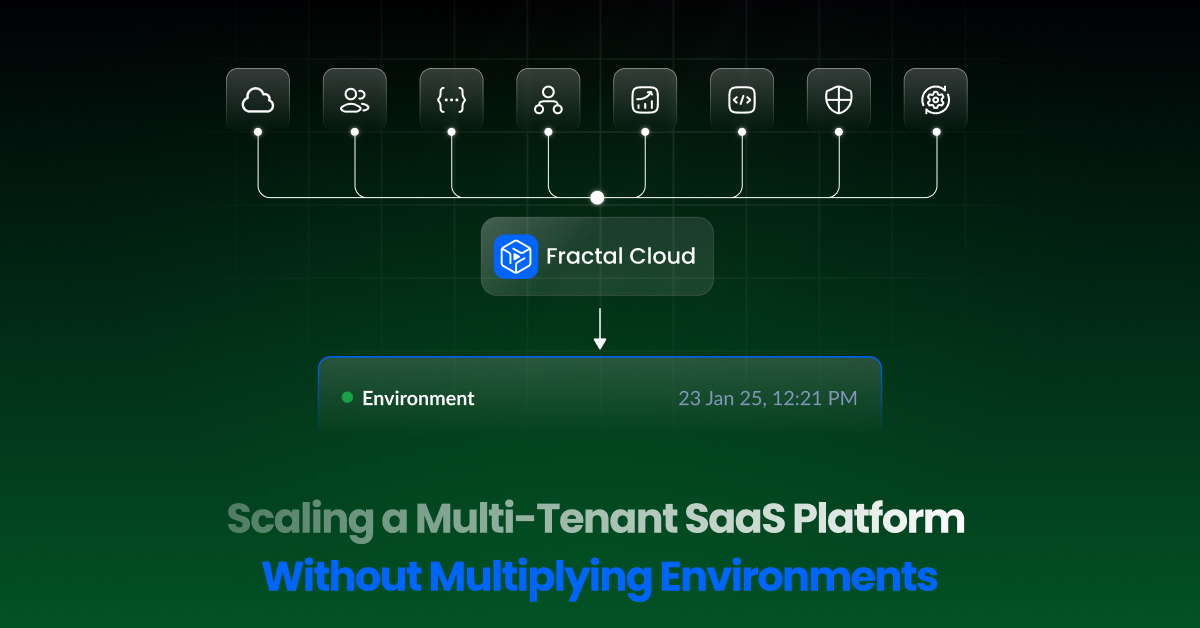
Multi-tenant SaaS scaling architecture showing centralized control plane and standardized environments without duplication

Scaling a Multi-Tenant SaaS Platform Without Multiplying Environments

Introduction

You land a new enterprise customer. The sales team celebrates. Then someone opens a Jira ticket to provision their isolated environment.The ticket goes to the platform team. Who checks what was done last time. Create a IaC workspace per tenant. Who runs the pipeline. Who reviews the networking. Who, two weeks later, hands over a URL.Scale that by ten customers. By fifty. You don't have a growth problem. You have an infrastructure production line problem, and it's about to become a ceiling.

The Real Cost of Per-Tenant Environments

Multi-tenancy in SaaS typically means one of two things:1. Shared infrastructure: all tenants run on the same cluster, partitioned by namespace, label, or logical isolation2. Dedicated infrastructure: each tenant gets their own environment: their own cluster, database, network configurationFor enterprise SaaS, dedicated is often required. Security requirements, data residency, compliance, SLAs - the moment you sell to a bank or a healthcare organization, shared infrastructure stops being an option.So you end up provisioning environments per tenant. And per environment you need:πŸ”· Kubernetes cluster (or node pool)πŸ”· Namespaces and RBACπŸ”· Network isolationπŸ”· Database instanceπŸ”· Observability pipelineπŸ”· Security policiesπŸ”· Backup configurationπŸ”· Billing tagsNow multiply that by your customer count. Multiply it by the number of environments per customer (staging, prod, UAT). Multiply it by the number of cloud regions you support.The math isn't the problem. The consistency is.

The Consistency Problem

When environments are provisioned manually (or via loosely coupled IaC modules) they diverge. Not immediately. Gradually.Team A enables encryption at rest because a customer asked for it. The next environment doesn't have it. Someone updates the Kubernetes version in one environment because a CVE was patched. The other thirty still run the old version.Six months later, you have thirty environments that look the same on the outside but behave differently on the inside. Debugging takes twice as long. Security audits become archaeology.This is drift. And drift is what kills multi-tenant SaaS platforms, not at customer one but at customer thirty.

Why "More Automation" Isn't Enough

The instinct is to automate more. Write better scripts. Build a CLI wrapper. Create a IaC workspace per tenant.It helps. But it doesn't solve the fundamental issue.The problem isn't that provisioning is slow. It's that infrastructure knowledge is locked in IaC code that only a few people can modify safely. Every tenant environment is a fork of that code slightly different, maintained in isolation, drifting over time.The goal isn't to automate provisioning faster. It's to make the infrastructure definition the single source of truth, one standard that every environment is derived from, that evolves uniformly and that enforces compliance automatically.

A Different Model: Infrastructure Standards, Not Templates

Fractal Cloud approaches this through what it calls Fractals reusable infrastructure constructs defined once by the platform team, consumed as-is by anyone who needs an environment.A Fractal for a multi-tenant SaaS platform might look like:When a new enterprise customer is onboarded, the platform team doesn't modify the Fractal. They instantiate it creating a new Live System from the same definition. The Fractal Automation Engine provisions every component, wires up the connections, applies the security policies, configures the observability stack.The result: environment N is not a copy of environment N-1. It's a fresh instantiation of the same standard.

What Changes at Scale

With a template model, scale means more copies of slightly different code.With a Fractal model, scale means more Live Systems derived from the same definition. When you update the Fractal - say, to bump the Kubernetes version or add a new security policy: every Live System that references it can receive that update in a controlled, auditable way.No more hunting down which environments got the patch and which didn't.For multi-tenant SaaS, this matters in concrete ways:Onboarding time: New tenant environments are provisioned in minutes, not days. No ticket. No manual IaC run. The platform team onboards the customer; the environment spins up automatically.Compliance audits: Every environment was built from the same Fractal. Same security policies. Same encryption. Same audit logging. Proving compliance isn't an investigation it's a statement of fact.Incident debugging: When something breaks in tenant X's environment, your team is debugging the same architecture they know from every other tenant - not a bespoke configuration that someone put together eighteen months ago.Cloud flexibility: The same Fractal definition can resolve to AKS on Azure, EKS on AWS, or GKE on GCP, depending on the tenant's cloud requirement. You write the standard once. The platform handles the cloud-specific implementation.The Self-Service AngleOne underappreciated benefit: once Fractals are defined, tenant onboarding doesn't have to go through the platform team every time.With Fractal Cloud, provisioning can be triggered via API, SDK, or CI/CD pipeline. Your onboarding automation calls the Fractal API. The environment is created. The tenant gets access.Your platform team designed the standard. They don't need to be in the loop for every instantiation.This is what developer self-service looks like for the platform team's internal customers in this case, the business and the customer success team who need environments provisioned, not just the developers who consume them.

Key Takeaways

πŸ”· Multi-tenant SaaS environments don't have a provisioning speed problem, they have a consistency and governance problem at scaleπŸ”· Template-based IaC creates divergence; reusable infrastructure standards create consistencyπŸ”· Fractals as a concept separate the infrastructure definition from the instantiation, one standard, many Live SystemsπŸ”· When environments are derived from the same definition, compliance, debugging, and upgrades become manageable at scaleπŸ”· Self-service provisioning removes the platform team from the critical path for every tenant onboardingReady to see how Fractal Cloud works for multi-tenant infrastructure? Check out the docs.Build Faster, Run Anywhere.

Cut the Wait. Reduce the Cost.Keep Control.

More articles

Illustration of Fractal Cloud orchestrating infrastructure components, highlighting how internal platforms can become bottlenecks

When Internal Platforms Become Bottlenecks

Over the last decade, many organizations have embraced Platform Engineering as a way to accelerate software delivery.The promise is compelling: build an internal platform that provides developers with standardized tools, infrastructure, and automation so they can focus on building applications instead of managing environments.In theory, this should increase productivity, improve governance, and reduce operational overhead.In practice, things are often more complicated.

Simplifying NIS2 compliance in multi-cloud environments through standardized infrastructure and automation

NIS2 and Cloud: how to simplify compliance without slowing down development

πŸ”Ή Executive takeawayNIS2 compliance is a matter of operational scale, not just regulation.Manual approaches are not sustainable in multi-cloud environments.Standardizing infrastructure is the most effective way to reduce risk and complexity.Embedding compliance into the platform allows you to accelerate without losing control.The NIS2 directive introduces new cybersecurity requirements for European organizations.The problem in 2026 is not understanding them.It’s implementing them in complex cloud environments without increasing operational complexity or slowing down development.Fractal Cloud addresses this challenge by integrating security, governance, and automation directly into the infrastructure.

Fractal Cloud Security by Design with built-in compliance in every Fractal

Security by Design: How Every Fractal Comes With Compliance Built In

There's a pattern in engineering organizations that have grown fast. Security works like this: developers provision infrastructure, then a security review happens, then issues get filed, then someone fixes them, then another review. The loop takes days. Sometimes weeks.This isn't security. It's security theater with a delayed blast radius.The deeper problem: when security lives in the process around infrastructure, it can't keep pace with the infrastructure itself. Every new team, every new cloud account, every new environment is another opportunity for the process to break down.This post is for platform teams and DevOps engineers who are tired of security being a bottleneck rather than a baseline. We'll cover why bolt-on security doesn't scale, what "security by design" means at the infrastructure level, and how Fractal Cloud implements it.