Fractal Sprint | Webinar: How to Build a Governed Developer Platform | Watch Now →

Announcing Hetzner Cloud support in Fractal Cloud

Fractal Cloud and Hetzner partnership announcement highlighting multi-cloud support

Introduction

Today we are adding Hetzner Cloud to Fractal Cloud. Teams that choose Hetzner for European sovereignty can now provision secure, production‑ready Kubernetes and move workloads across vendors with a single, automated workflow. The result is developer self service with governance built in, and a clear path to sovereign multicloud without lock in.

Why this matters

Many European companies prefer Hetzner to meet data residency and sovereignty goals. Until now, getting a safe, auditable and scalable developer platform on Hetzner required custom engineering and manual guardrails. Fractal Cloud removes that work. You get ready to use infrastructure that meets security and compliance needs while keeping developer experience simple.

What is available today

🔷 Fully managed Kubernetes on Hetzner Cloud, optimized for scale and resilience;🔷 Secure by default with RBAC, defense in depth, automated internal PKI and mutual TLS across services;🔷 Safe developer self service with namespace level access and automated deploy permissions;🔷 Complete audit trails that show who changed what and when;🔷 One workflow to migrate workloads across cloud vendors to support sovereign strategies;🔷 Consistent operations across providers using the same blueprints and controls.

How it works

Fractal Cloud is a platform engineering solution that delivers secure, compliant infrastructure across any cloud. It gives developers ready to use building blocks and architecture templates while operations teams govern through centralized automation and policy. Under the hood, the Fractal Automation Engine orchestrates every step. Fractals are defined with our SDK in general purpose languages, today Java and next C# and Typescript. No domain specific language is required. No Terraform, Bicep or CloudFormation is needed. The Automation Engine replaces traditional IaC scripting with versioned blueprints and controlled operations.What you do:🔷 Pick a blueprint for your application pattern;🔷 Choose Hetzner as the provider and instantiate;🔷 Grant teams access by namespace with built in RBAC;🔷 Operate with standard actions for update, scale, rotate secrets and more;

Security and governance by design

Every environment instantiated through Fractal Cloud applies consistent controls. Identity, network policy, logging, backup and observability are wired in from the start. Changes are tracked. Updates can be rolled out in a controlled way. Teams ship faster without bypassing reviews, and platform owners keep a single source of truth for policy.

Portability as a strategy

Sovereign cloud is not just about where you run. It is about how easily you can move. With Fractal Cloud, the same blueprint can target different providers without rewriting infrastructure. That gives customers the freedom to choose the best vendor over time, the same way they switch phone operators, and it gives emerging European cloud providers a fair path to compete.

Beyond hyperscalers

This is only the beginning. With Fractal Cloud you can deploy and manage services that are available only on hyperscalers, as managed functions (FaaS), databases (DBaaS) and more. Our goal is to minimize differences across vendors so platform teams expose one experience, and developers focus on applications rather than vendor specifics.

Who benefits

Developers: ship without tickets. Use production ready templates. No deep cloud expertise required.Infrastructure and Operations: standardize once. Enforce policy everywhere. Monitor and update through one control plane.Technology leaders: lower risk from vendor lock in. Improve time to market. Align cloud choices with sovereignty goals.

Get started

If you run on Hetzner Cloud or plan to adopt a sovereign multicloud approach, we can help you move quickly and safely.Next steps:🔷 Book a walkthrough of Hetzner on Fractal Cloud🔷 Bring a pilot workload and see automated migration in action🔷 Explore how your platform team can publish internal blueprints with our SDKCreate your account or request a demo!Build Faster, Run Anywhere.

Frequently asked questions

Why is Hetzner Cloud a good choice for sovereign cloud initiatives?

Hetzner is a European provider, so both the infrastructure and the company that operates it sit under EU jurisdiction. That answers two of the three questions sovereignty raises: where the data is stored, and whose law governs the provider. The third question is whether you can leave. Fractal Cloud answers that one: the same versioned definition used to provision a Hetzner environment provisions the equivalent environment on another provider, so choosing Hetzner does not create a new dependency.

Can I run production Kubernetes workloads on Hetzner Cloud?

Yes. Fractal Cloud supports production ready Kubernetes environments on Hetzner Cloud with security, resilience, and operational best practices built in. Platform Teams can standardize Kubernetes environments, while Development Teams deploy and manage applications through reusable Blueprints and automated workflows.

How does Fractal Cloud simplify Kubernetes operations on Hetzner?

Fractal Cloud automates the provisioning and lifecycle management of Kubernetes environments on Hetzner Cloud. Platform Teams define reusable blueprints with built in security, governance, and operational controls, while Development Teams deploy and manage applications through standardized workflows without dealing with provider specific infrastructure details.

Can I migrate workloads between Hetzner Cloud and other cloud providers?

Yes, with one distinction worth making. Fractal Cloud recreates the target environment on the new provider from the same versioned definition, so the architecture, the policies and the operational setup come across unchanged. Application data and persistent state still have to be moved with the appropriate replication or backup and restore process. What normally makes a migration expensive is rebuilding and re-certifying the environment, and that part is already described in the Fractal.

More articles

The metric CTOs never look at: the average age of infrastructure debt

The metric CTOs never look at: the average age of infrastructure debt

A CTO watches uptime, team velocity, and the monthly cloud bill. Those three are easy to watch: they update themselves, they have dashboards, and they compare month over month without anyone building anything.Now try to answer a different question from those same three dashboards. For each production environment, how long has it been since it last matched the definition it was built from? Uptime cannot tell you. Velocity measures the code your teams ship, not the infrastructure they stopped touching. The bill goes up when things are neglected, not down, so it does not even point in the right direction.That question has a measurable answer, and almost nobody measures it.
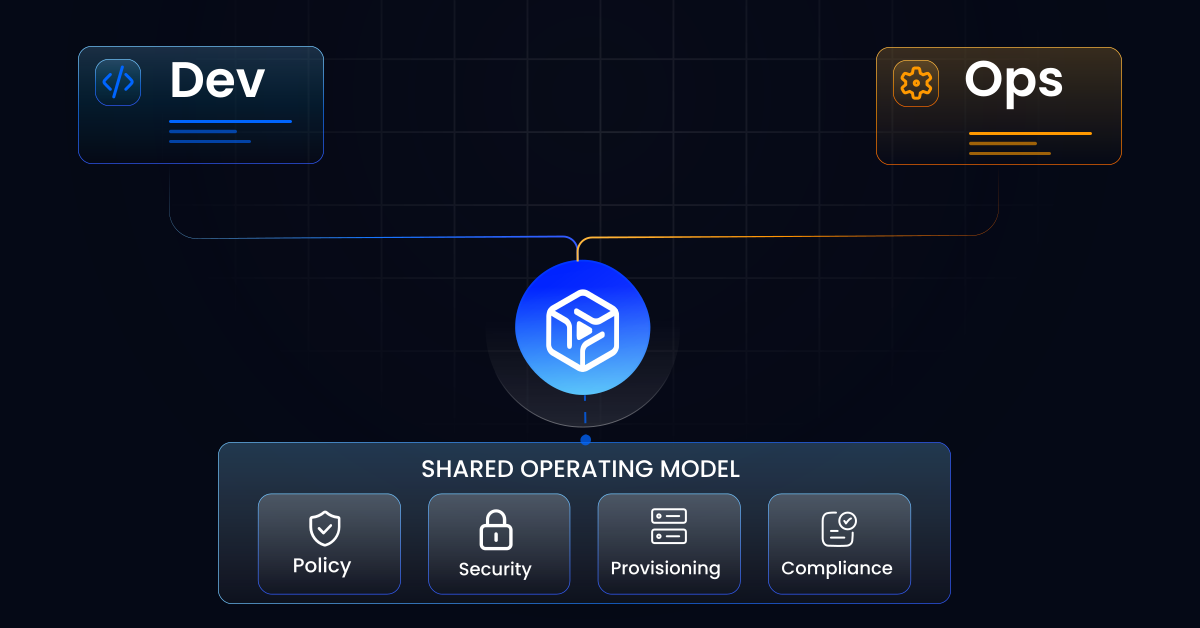
Diagram showing how a shared operating model aligns development and operations teams through Platform Engineering.

How to Align Dev and Ops Without Adding More Tools

Aligning infrastructure teams and development teams comes down, first of all, to the operating model. Tools matter, but on their own they explain little of what slows delivery down.Over the past few years almost every organization has tried to speed up delivery by adopting cloud, containers, and CI/CD pipelines. The outcome tends to repeat itself: developers want to move fast, while whoever runs the infrastructure has to guarantee security, compliance, and cost control. A structural conflict follows, where developers experience controls as a brake and Ops read team autonomy as a risk.There is a fairly precise way to measure that conflict: the cognitive load on developers, meaning how much they have to hold in their head before they can ship. When every team needs Kubernetes, Terraform, IAM policies, and the quirks of each provider, the time spent wiring infrastructure together is time taken from the product. Gartner estimates that by 2026, 80% of large software organizations will have a dedicated platform engineering team, up from 45% in 2022.The useful question, then, is how to design a system where speed and governance stop competing. It is the question Fractal Cloud was built around, and it deserves a general answer before a product one.

Why Great Observability Still Wakes You Up at 3 AM

Why Great Observability Still Wakes You Up at 3 AM

Closing the Loop Between Observability and InfrastructureMost organizations have good observability. They know within seconds when something breaks. And then someone gets paged.Alerts fire into runbooks, runbooks require humans, and humans are a bottleneck. The industry spent a decade solving the seeing problem. The acting problem is still largely manual.According to ITIC 2024 analysis, every minute of downtime costs a data center an average of $9,000. Speed and precision of response are not an operational detail: they are the factor that determines the final cost.There are two reasons this persists: operational data is fragmented across tool silos, so no single system has the full picture; and organizations don't trust automation they can't explain. Both problems need the same fix: a layer that contextualizes events across the full system, reasons deterministically about what to do, and executes infrastructure changes with full traceability.