[Live Webinar] Fractal Sprint: NIS2 & DORA: Turn Compliance into Architecture | Register Now →

Blog
How to align Dev and Ops: a question of operating model

How to align Dev and Ops: a question of operating model

Introduction

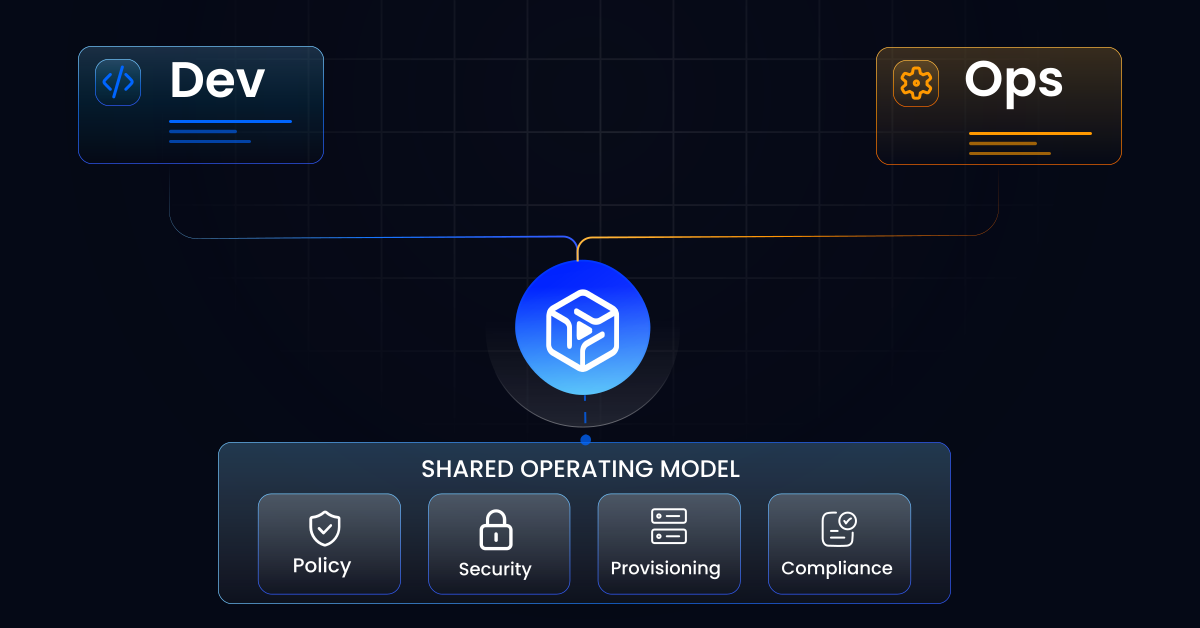
Aligning infrastructure teams and development teams comes down, first of all, to the operating model. Tools matter, but on their own they explain little of what slows delivery down.Over the past few years almost every organization has tried to speed up delivery by adopting cloud, containers, and CI/CD pipelines. The outcome tends to repeat itself: developers want to move fast, while whoever runs the infrastructure has to guarantee security, compliance, and cost control. A structural conflict follows, where developers experience controls as a brake and Ops read team autonomy as a risk.There is a fairly precise way to measure that conflict: the cognitive load on developers, meaning how much they have to hold in their head before they can ship. When every team needs Kubernetes, Terraform, IAM policies, and the quirks of each provider, the time spent wiring infrastructure together is time taken from the product. Gartner estimates that by 2026, 80% of large software organizations will have a dedicated platform engineering team, up from 45% in 2022.The useful question, then, is how to design a system where speed and governance stop competing. It is the question Fractal Cloud was built around, and it deserves a general answer before a product one.

The real problem: every change goes through another team

In many companies infrastructure is still governed through tickets, manual approvals, custom scripts, and knowledge that lives in the heads of a few people. Engineers call it organizational coupling: no team can move until another team moves first. A new developer waits days for an environment, and sometimes weeks before a first deploy that matters.Over time this hardens into organizational debt. Like technical debt, it builds up quietly. Every workaround, every undocumented step, every "just ask Marco, he knows how the network is set up" adds a small interest payment the whole company keeps making. It rarely shows up on a dashboard, yet it shows up in slower releases, tired engineers, and people who leave taking critical knowledge with them.The model does not scale either: every new team adds operational load, and every extra provider multiplies the combinations to keep under control. A quick test of whether this is your situation:🔷 A new environment takes days, and nobody finds that strange anymore.🔷 Only two or three people can touch networking or IAM, and everything queues behind them.🔷 No one can say what is running in which account right now, or whether it is still compliant.🔷 The best engineers spend their weeks on internal plumbing instead of the product.Two or more of these, and the problem is the operating model, not the people.

Platform engineering: infrastructure as a product

Platform engineering emerged to break this dependency. Ops design and maintain pre-validated golden paths, and development teams consume them in self service, from a catalog of ready-to-use products.A mature platform is run as an internal product: it has a roadmap, gathers feedback, and gets judged by the experience it offers, with development teams as its customers. That is the distance between a portal nobody opens and a platform the company builds on.Taking the idea seriously means infrastructure itself becomes a product too: reusable, versioned, maintained over time. A blueprint captures a whole architecture, components and connections included, independent of the provider underneath. Defined once, the same pattern runs on any cloud, gets updated in one place, and stays consistent in every environment.The split of responsibilities becomes clean. The platform team defines approved blueprints and bakes in security, compliance, and cost control. Development teams pick a blueprint, spin up environments on their own, and leave the cloud details to the platform. More autonomy sounds like less control, but the opposite happens: the rules live in the platform's code and apply to every provisioning up front, so nobody negotiates permissions at each step and inefficient configurations get caught before they reach production.

The real test is day two

Most platform initiatives get judged on day one: how fast a team can get a new environment. But an environment gets created once and then operated for years. Day one is the demo. Day two is the job: updates, patches, drift, policy changes, audits, retiring what nobody uses anymore.Day two is where homegrown platforms struggle. An Internal Developer Platform built on Terraform modules, CI/CD pipelines, and a portal automates day one well. Then templates fork team by team until nobody wants to maintain them, environments drift apart across providers, governance arrives downstream once the choices are already made, and no one keeps a reliable picture of what is running where. The platform exists, but Dev and Ops end up as entangled as before, one level up.

Fractal Cloud in practice

Fractal Cloud starts from day two. Platform teams define infrastructure patterns once, as governed products; development teams consume them on their own; the platform keeps every environment consistent, compliant, and accounted for, for as long as it runs.Three components carry the weight. Fractal Blueprints are the patterns: versioned definitions of a complete architecture, written with the Fractal SDK in a general-purpose language like Java rather than templates or a DSL. They are cloud agnostic by design, so the same blueprint runs on AWS, Azure, GCP, or OCI without changes.The Fractal Automation Engine takes care of the life that follows: it validates, provisions, configures, and connects the resources, then keeps applying updates, correcting drift, and retiring what is no longer needed. Live Systems are the running instances, each one traceable and checked against the policies it started with. The question "what is running, where, and is it still compliant" has an answer at any moment, not only when an audit forces one.Seen from inside a team, the change is plain. The developer who waited days now picks an approved blueprint and has a production-ready environment in minutes, secure and compliant out of the box. The platform engineer who used to answer tickets defines blueprints and guardrails once, then oversees every Live System from a single place. Nobody files a ticket, nobody chases Marco, and the first deploy that matters happens in the first week instead of the second month.The difference from a homegrown IDP is the day-two one. Blueprints evolve in one place instead of forking team by team, environments stay governed as Live Systems instead of drifting apart, and the rules travel inside the blueprint instead of arriving as a review afterwards. Day one gets faster too, but that was never the hard part.

In short

Speeding up time to market while keeping governance firm is a matter of operating model. Organizations that adopt GitOps and mature platforms report up to 70-80% fewer deployment errors, and the time to provision an environment drops from days to hours. Get the model right and the organizational debt from earlier starts to shrink.The move that matters runs from infrastructure managed by hand to infrastructure designed, versioned, and consumed as a product. Judge the result on day two, not on the demo. Fractal Cloud exists to make that move practical, and with a platform built this way, speed and control come from the same decision.

More articles

How to align Dev and Ops: a question of operating model

How to align Dev and Ops: a question of operating model

Aligning infrastructure teams and development teams comes down, first of all, to the operating model. Tools matter, but on their own they explain little of what slows delivery down.Over the past few years almost every organization has tried to speed up delivery by adopting cloud, containers, and CI/CD pipelines. The outcome tends to repeat itself: developers want to move fast, while whoever runs the infrastructure has to guarantee security, compliance, and cost control. A structural conflict follows, where developers experience controls as a brake and Ops read team autonomy as a risk.There is a fairly precise way to measure that conflict: the cognitive load on developers, meaning how much they have to hold in their head before they can ship. When every team needs Kubernetes, Terraform, IAM policies, and the quirks of each provider, the time spent wiring infrastructure together is time taken from the product. Gartner estimates that by 2026, 80% of large software organizations will have a dedicated platform engineering team, up from 45% in 2022.The useful question, then, is how to design a system where speed and governance stop competing. It is the question Fractal Cloud was built around, and it deserves a general answer before a product one.

When Your Digital Twin Has Hands

When Your Digital Twin Has Hands

Closing the Loop Between Observability and InfrastructureMost organizations have good observability. They know within seconds when something breaks. And then someone gets paged.Alerts fire into runbooks, runbooks require humans, and humans are a bottleneck. The industry spent a decade solving the seeing problem. The acting problem is still largely manual.According to ITIC 2024 analysis, every minute of downtime costs a data center an average of $9,000. Speed and precision of response are not an operational detail: they are the factor that determines the final cost.There are two reasons this persists: operational data is fragmented across tool silos, so no single system has the full picture; and organizations don't trust automation they can't explain. Both problems need the same fix: a layer that contextualizes events across the full system, reasons deterministically about what to do, and executes infrastructure changes with full traceability.

Composable cloud architecture with modular infrastructure and governance components in Fractal Cloud

Composable Architecture: How to Build Platforms That Scale Without Multiplying Complexity

There's a pattern that appears in every infrastructure organization that has grown without a deliberate architectural philosophy.Twelve different Kubernetes configurations. Four different ways to define a database. Three different networking approaches. None of them wrong. None of them the same.The platform team spends more time understanding what's already running than building what should run next. New systems aren't built they're spawned from the nearest available precedent, carrying forward every quirk and accidental decision of whatever they were copied from.This post is about the architectural model that improves this cycle: composability. For platform engineers and architects who are tired of complexity accumulating faster than they can manage it.