Introduction
In the modern DevOps cycle, and with the rising adoption of Platform Engineering, many teams operate with distributed tools that separately handle provisioning, configuration, monitoring, and compliance. This approach increases dependence on cloud specialists and makes it difficult to maintain consistency across environments.With Fractal Cloud, these activities are integrated into a single Internal Developer Platform (IDP). Governance, security, and automation are embedded into versioned and reusable components called Fractals, which include technical blueprints, policies, and managed operations.
The problem: heterogeneous toolchains, distributed governance, slow delivery cycles
In the traditional model, Dev and Ops teams use different tools for each stage of the operational cycle:· Terraform, Ansible, or Helm for provisioning;· Prometheus and Grafana for monitoring;· Checklists and manual controls for security and compliance.While widely adopted, these tools are often disconnected from one another and require specialized expertise in each context. Every new environment involves weeks of configurations, tickets, and validations. The result? Delays, inconsistencies across environments, and fragmented governance.Note: Fractal Cloud does not rely on Terraform, Bicep, or other traditional IaC tools. Infrastructure is defined declaratively through its SDK (currently in Java, soon also in C#), an advanced approach to Infrastructure as Code (IaC) which allows teams to write reusable blueprints in a general-purpose programming language.
How can reusable Blueprints unify Governance and Speed?
The solution is to build a "paved road" for developers using reusable blueprints that bake governance directly into the development workflow, rather than making it a manual checkpoint.Centers of Excellence (CoEs) define and publish Fractals: reusable infrastructure units that combine technical blueprints, security policies, and predefined operations.Fractals are not scripts but versioned and validated infrastructure components, which development teams can independently instantiate via SDK or CLI. Each Fractal includes:· Preconfigured components aligned with company standards;· Secure operations accessible via code;· Integrated policies for security, networking, logging, and backup;· Automatic updates orchestrated by the platform.CoEs do not handle provisioning directly: they define policies and architectures, which are then consumed autonomously by Dev teams in a self-service model within their CI/CD pipelines.
How to overcome a fragmented DevOps Toolchain?
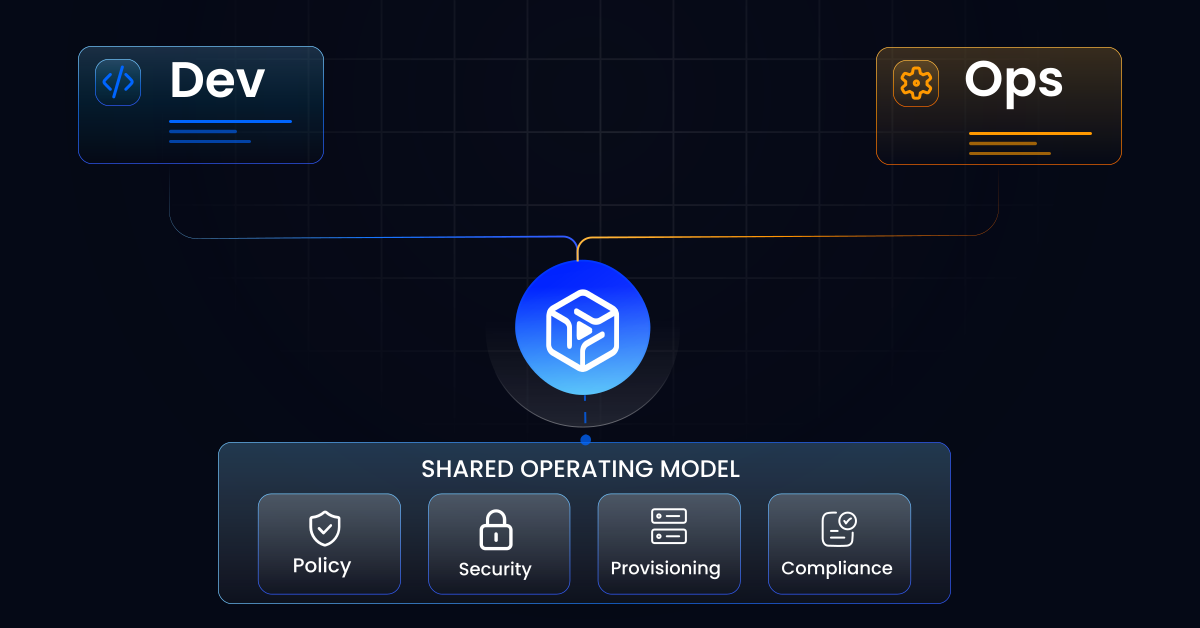
At the top: Traditional DevOps model, fragmented and dependent on heterogeneous tools. At the bottom: Fractal Cloud automates the entire Ops layer, from deployment to monitoring, all the way to governance.In the traditional model shown above, the DevOps cycle relies on a heterogeneous toolchain that requires separate tools for deployment, monitoring, and compliance management. This approach increases operational complexity and dependence on specialized skills.Fractal Cloud, illustrated below, replaces this fragmentation with a single platform that integrates automation, security, and governance directly into Fractals. Ops teams no longer need to orchestrate different tools for each phase: the entire operational flow is embedded in versioned and reusable components.With Fractal Cloud:· Platform teams publish reusable Fractals;· Development teams integrate them into their CI/CD pipelines;· CoEs maintain centralized control without creating bottlenecks.At the center of this operating model is the Fractal Automation Engine, which:· validates blueprints;· performs provisioning;· automatically configures components;· continuously manages updates.It is not just an execution engine, but the key element that enables infrastructure evolution and governance at scale.
You no longer have to choose between Governance and Speed
Integrating Fractal Cloud into your operational pipeline enables you to achieve:· Secure, standardized provisioning, without tickets;· Automated compliance, without manual audits;· Centralized governance, with distributed autonomy;· Faster release cycles, with pre-approved environments;· Up to 30% cloud cost savings, enabling effective cloud cost optimization thanks to Fractals’ reusability and reduced custom configurations;· Up to 70% reduction in the need for specialized technical skills, since Fractals abstract cloud complexity and let teams focus on the application.
Ready to eliminate operational complexity and transform your Platform Engineering approach?
Fractal Cloud enables teams to codify governance once and apply it anywhere, through production-ready Fractals.It eliminates the need to orchestrate a heterogeneous toolchain and provides a single platform to build, update, and monitor your cloud environments.Code Faster, Run Anywhere.