Blog
What "Cloud-Agnostic" Really Means in 2025 (And Why It's Not What You Think)

What "Cloud-Agnostic" Really Means in 2025 (And Why It's Not What You Think)

Introduction

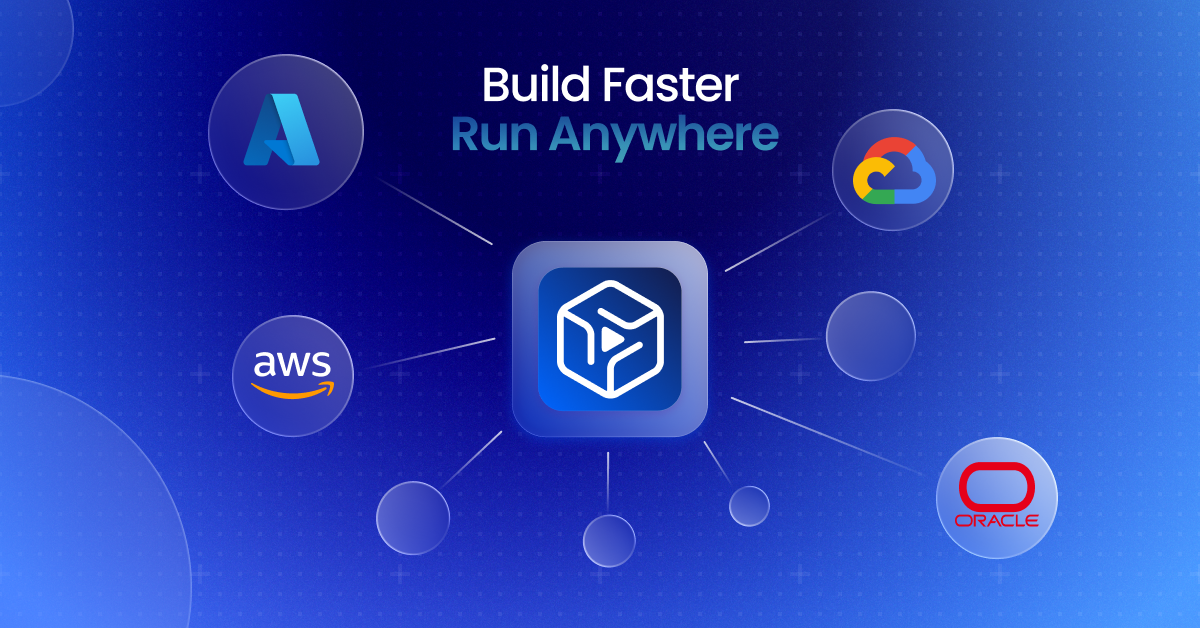
"Cloud-Agnostic" is one of the most seductive and misunderstood buzzwords in our industry. For years, we've been sold a utopia: the promise of building an application once and then freely moving it between AWS, Azure, and GCP with a single click, as if they were interchangeable utilities.In 2025, it's time to say it clearly: this idea no longer reflects the complexity of real-world cloud architectures.Chasing the "run anywhere" myth leads companies to build bland, lowest-common-denominator systems that fail to leverage the true power of any cloud. You end up paying the price of the cloud without enjoying its main benefits.But this doesn't mean the idea is worthless. It just means the real value isn't where we've been told to look. True "cloud-agnostic" isn't about implementation portability; it's about architecture standardization.

The Myth of Total Portability

Why is moving a complex workload with one click a utopia? Because the real value of the major providers doesn't lie in their "virtual machines" or generic storage. Those are just the foundation. The real value is in their proprietary, managed services: a high-performance global database, a specialized AI service, a serverless platform with deep integrations.To be truly "portable," an application would have to actively avoid all of these services, effectively giving up the primary reason for choosing that provider in the first place. You end up building a complex system that doesn't excel anywhere and requires a massive maintenance effort just to remain "agnostic."Vendor lock-in isn't an enemy to be defeated at all costs; it's a trade-off to be managed strategically.

Redefining "Cloud-Agnostic": From Portability to Standardization

If we stop chasing the myth of one-click migration, we can focus on the real problem: how can we use the best services from each cloud without falling into architectural chaos?This is where the true meaning of "agnostic" in 2025 emerges: defining a standard architecture that can be implemented on different providers.Instead of looking for a single tool that works everywhere, you define a standard architectural pattern for the company. For example, a "web application pattern" might require:1. A scalable, containerized compute layer.2. A managed relational database.3. Object storage for static files.4. A message queue for asynchronous operations.This pattern is your standard. It is agnostic.The implementation of this pattern, however, will be intentionally specific to each cloud to maximize performance and reduce costs:· AWS: It will use EKS + RDS + S3 + SQS. · On Azure: It will use AKS + Azure SQL + Blob Storage + Service Bus.The architecture and the interfaces between components remain consistent, but the underlying implementation is optimized for the chosen provider.

The Advantages of a Standardized Architecture

This approach shifts vendor lock-in from the architectural level (the most dangerous kind, as it locks in your way of thinking) to the implementation level (a calculated trade-off). The advantages are enormous: · Consistency and Governance: Your teams don't reinvent the wheel. They apply an approved pattern, for which governance and security have already been defined centrally.· Strategic Flexibility: You can decide to run AI workloads on one provider, data analytics on another, and web apps on a third, all while maintaining total architectural consistency.· Reduced Real Lock-in: Your team thinks in terms of "message queues," not "SQS." This conceptual decoupling is true freedom. It makes it possible to plan a migration (even if complex) and gives you enormous negotiating power with vendors.

How to Achieve It: Standardizing Patterns with a Component Approach

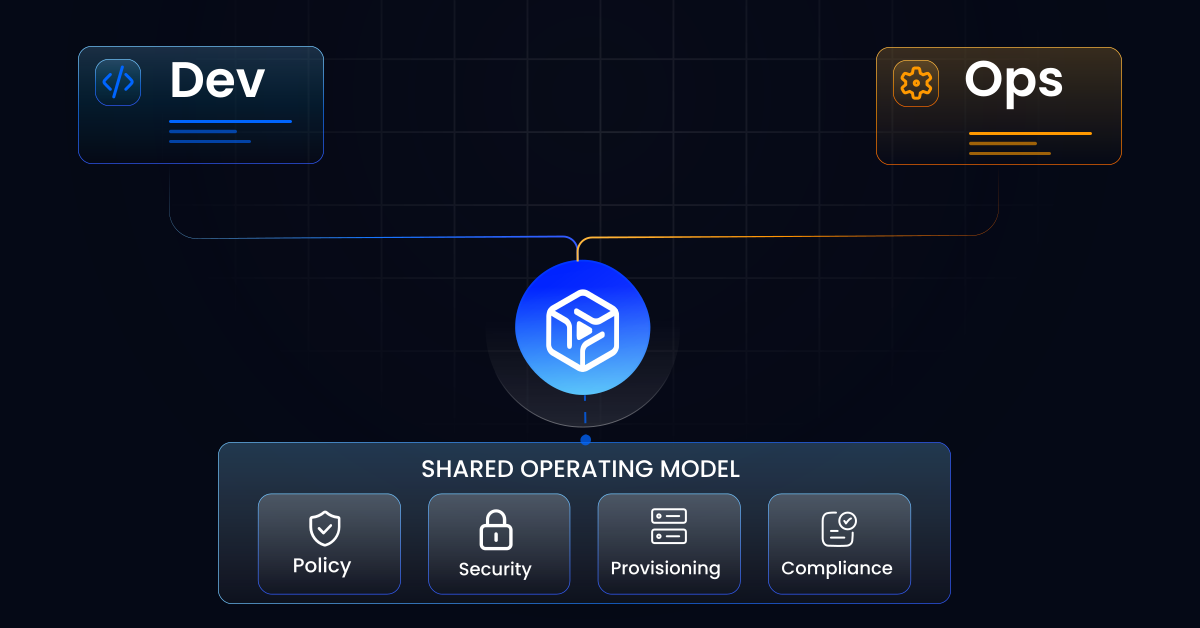
Defining these standards in a Word document is useless. No one will read it, and governance will be impossible to enforce. To work, this approach requires a platform that can codify these architectural patterns.And this is exactly where Fractal Cloud comes in.Fractal Cloud allows you to translate these standardized patterns into reusable, composable components: "Fractals."A Platform Team can use Fractal to define a "Web Application Fractal" that completely abstracts the architecture. This Fractal defines what is needed (the pattern), but not how it's implemented. It's the underlying Blueprint that then maps that abstract pattern to the specific, optimized implementations for AWS, Azure, or GCP.This is true "cloud-agnostic" in practice:1. Development teams consume a standardized "Fractal" without having to worry about the underlying provider.2. The Platform Team maintains control, ensuring that every implementation (AWS, Azure) is optimized, secure, and compliant with company policies.In this way, Fractal doesn't chase the illusion of portability. It provides the only thing that truly matters: the guarantee of consistency and governance at scale, regardless of which cloud you choose to operate on.

Real Agnosticism is an Architectural Choice

Let's stop asking, "How can I move this workload?" Let's start asking, "How can I standardize this architecture?"The "cloud-agnostic" of 2025 isn't a magic tool; it's a strategic engineering discipline. It's the ability to define your own architecture and have the providers adapt to it, not the other way around. Fractal Cloud provides the tools to turn this strategy into an executable reality.

More articles

What "Cloud-Agnostic" Really Means in 2025 (And Why It's Not What You Think)

What "Cloud-Agnostic" Really Means in 2025 (And Why It's Not What You Think)

"Cloud-Agnostic" is one of the most seductive and misunderstood buzzwords in our industry. For years, we've been sold a utopia: the promise of building an application once and then freely moving it between AWS, Azure, and GCP with a single click, as if they were interchangeable utilities.In 2025, it's time to say it clearly: this idea no longer reflects the complexity of real-world cloud architectures.Chasing the "run anywhere" myth leads companies to build bland, lowest-common-denominator systems that fail to leverage the true power of any cloud. You end up paying the price of the cloud without enjoying its main benefits.But this doesn't mean the idea is worthless. It just means the real value isn't where we've been told to look. True "cloud-agnostic" isn't about implementation portability; it's about architecture standardization.

Announcing Hetzner Cloud support in Fractal Cloud

Announcing Hetzner Cloud support in Fractal Cloud

Today we are adding Hetzner Cloud to Fractal Cloud. Teams that choose Hetzner for European sovereignty can now provision secure, production‑ready Kubernetes and move workloads across vendors with a single, automated workflow. The result is developer self service with governance built in, and a clear path to sovereign multicloud without lock in.

Designing for Resilience: from Disaster Recovery to Strategic Advantage

Designing for Resilience: from Disaster Recovery to Strategic Advantage

In cloud engineering, there is a fundamental truth: systems fail. It's not a matter of "if," but "when." Provider Service Level Agreements (SLAs), with their "nines" (99.9%, 99.99%), are not a promise of infallible uptime; they are the contractual guarantee that failures, however rare, are an expected part of the service.The "Shared Responsibility" model is clear: the provider is responsible for the reliability of the infrastructure, while we are responsible for the reliability of our applications running on it.When a core service or an entire region goes offline, it's not a "betrayal." It's an expected operational event. The real question isn't why it happened, but how we respond.