Fractal Sprint | Webinar: How to Build a Governed Developer Platform | Watch Now →

Top 10 Platform Engineering Best Practices

Fractal Cloud interface concept: a New Live System panel built from a versioned Fractal Blueprint, with governance built in, deployment on any cloud and drift reconciled on Day 2.

Introduction

Search "platform engineering best practices" and every list repeats the same five words: golden paths, platform as a product, less cognitive load. True, and not enough. What does a golden path look like the moment a developer clicks "create environment"? What breaks if a team skips it?Here are 10 practices with that next layer attached. Check a few against your own setup this afternoon.

1. Treat the platform as a product, not a project.

A project ships, and the team that built it moves on. A product has an owner, a roadmap shaped by the people who use it, and a channel where those people can complain when something breaks. Skip that structure, and a platform gets built once, during a six-month mandate, and then nobody owns it.The fix is naming an owner before the first line of infrastructure code gets written, the same way a company names a product manager before a feature ships.

2. Make the golden path the fast path, and speak the developer's language, not the provider's.

A gate blocks the shortcut without offering an alternative, so a team routes around it the moment nobody is watching. A golden path takes the opposite approach: it makes the proper way the fastest option on the table. Test it on your own platform: is the approved route to a new environment faster than doing it by hand? If it is not, the gate is decorative.The path also has to speak in terms a developer already understands. A console with "some limits applied" still forces someone to learn IAM roles, network segments, and naming conventions first. Real self-service takes the request in application terms: a database, a queue, an API. It resolves every provider-specific decision behind the scenes, and the developer fills in three fields without ever opening a console.When the approved route is also the fastest one, teams stop working around it.

3. Put governance inside the definition, not layered on after.

A security review that runs after a team has already built something has two outcomes. It blocks a launch under deadline pressure, or someone approves it anyway to hit the date. Neither is real governance: one is friction, the other is approval without a real check.Put encryption, network policy, and access control inside the template itself, and review stops being a separate step. Nothing non-compliant is buildable to begin with, so nothing is left to catch on the way out.

4. Standardize the pattern your teams share, not just the tooling.

Sharing a Terraform module library is not the same as sharing an architecture. Two teams can call the identical module with different flags for encryption, backup, and networking, and end up running two different systems that happen to share some source code. The module was standardized. The architecture was not.The better move is to standardize the complete pattern: the versioned combination of components, policies, and defaults a team deploys. The modules underneath can stay an implementation detail.Sharing a module is not enough: without a shared pattern, the same code produces different systems.

5. Build for portability from day one, because sovereignty is a matter of speed, not geography.

Most teams discover how many provider-specific assumptions sit inside their Terraform during a vendor renegotiation, or when a new data residency rule lands on someone's desk. By then, portability is an emergency migration project, not a design choice made months earlier.Build the abstraction in from the start, and a definition can target one cloud today, and a different region or provider next year, with no rewrite. The sharp question is not which regional provider hosts the data. It is whether a workload can move the moment a regulation, a contract, or a vendor relationship requires it. A portable platform can answer quickly, because moving the workload does not mean rewriting it first.

6. Make governance continuous: catch drift immediately, and let the system fix what it already trusts.

A drift check that runs once a night, or once per pipeline, leaves a window open. Inside it, two versions of the truth disagree: what the environment looks like, and what its definition says it should look like. An incident, an auditor, or a customer might find the gap before anyone on the team does. Continuous detection shrinks that window from hours to minutes.Detection alone still leaves a person waiting at a terminal for every alert. Some situations do not need that wait: a security group opened by hand during an incident, or a tag removed by a stray click. The system already knows how to fix these, so it can revert them on its own and log what happened, leaving human escalation for changes nobody has approved a fix for yet. Fractal Cloud's own drift detection runs continuously rather than on a schedule, and reconciliation happens without anyone opening a ticket.Periodic scans leave a window where the live state no longer matches the definition.

7. Give every environment a definition anyone can name, and a clear line for who can change what.

"Which configuration is production actually running" should have one answer anyone on the team can look up, not a guess from a Slack thread. If nobody can name the current version, that environment already has an audit finding waiting to be discovered.The harder question is who gets to change it. Full autonomy produces a hundred slightly different versions of the same pattern, each a decision nobody reviewed. Zero autonomy produces a queue teams go around the moment a deadline gets close. A defined interface is the middle ground: a specific set of operations to specialize a pattern, while the network layout and the compliance controls stay under central control. Just remember a clean portal in front of five inconsistent ways to provision a database is still five inconsistent ways to provision a database, with a nicer button on top.

8. Measure the platform like a product: outcomes, not activity.

Tickets closed measures how busy the platform team looks, not whether the platform works. A team can close a thousand tickets a month and still lose ground on every number that matters.Three metrics tell a more honest story. Delivery lead time shows whether a team can ship. Change failure rate shows whether a change breaks something after release. Self-service adoption shows whether people choose the platform when they have another option. That last one is easy to miss, because a platform teams avoid does not fail loudly. It fails one workaround at a time.

9. Build the platform for every way people reach it, including the agents that will start reaching it too.

A new console is one more login and one more tab someone has to remember exists. The stronger move is exposing the platform through a REST API, so a request from a ServiceNow catalog, or a merge on a GitLab pipeline, can trigger provisioning without anyone opening a separate tool.That principle matters more every year. An AI system that can request, check, or adjust infrastructure on a team's behalf is turning from a novelty into a basic requirement, and a platform that only speaks through a UI cannot let one in safely. The API, the CLI, and the SDK are the governed way to let all of that in: a person, a script, or eventually an agent, each using the interface that fits them, instead of forcing every request through one screen.One platform, reachable from the portal, the CLI, the API and the tools teams already use.

10. Plan for Day 2 from Day 1.

Day one is the demo: a team creates the environment, and everyone claps. Day two is patches, policy changes, drift, and eventually the decommission. It lasts for the life of the environment, usually years longer than the demo did.A platform judged only on how fast it creates things is judged on the smaller half of the job. The bigger half is quieter. Does anyone know what is running six months from now? Is it still compliant? Can someone turn it off cleanly when nobody needs it anymore? Build for that half on purpose. Nobody claps for it, and nobody notices it is missing until the day they need it.None of these 10 need a platform rebuild to start. Pick the one your last incident retro pointed at. Fix that one, then move to the next.Provisioning takes minutes; patching, policy changes and decommissioning go on for years.

How Fractal Cloud helps you apply these practices.

Most of these practices fail at the same point: the rules sit in a document, while the infrastructure sits somewhere else. Fractal Cloud is a platform engineering solution that bridges this gap by putting the rules directly inside the components your teams deploy.Your platform team defines a "Fractal" once, a versioned pattern with components, policies, and allowed changes. Teams then deploy it independently, without tickets and without a cloud console, across AWS, Azure, Google Cloud, OCI, or on-premises.The results are immediate. As a prime example of the impact, a Cloud Ops team of 4 people serves 18 development teams: their infrastructure tickets dropped from ~25 a week to almost zero.How it maintains your infrastructure:🔷 Built-in Compliance: The platform refuses non-compliant changes right at deploy time.🔷 Automated Drift Correction: A Cloud Agent compares the real state with the declared state and fixes differences automatically.🔷 Seamless Patching: When a shared component needs an update, one version change reaches every environment that depends on it.A Fractal is defined once and runs as a governed Live System on any supported provider.

More articles

Fractal Cloud interface concept: a New Live System panel built from a versioned Fractal Blueprint, with governance built in, deployment on any cloud and drift reconciled on Day 2.

Top 10 Platform Engineering Best Practices

Search "platform engineering best practices" and every list repeats the same five words: golden paths, platform as a product, less cognitive load. True, and not enough. What does a golden path look like the moment a developer clicks "create environment"? What breaks if a team skips it?Here are 10 practices with that next layer attached. Check a few against your own setup this afternoon.

Platform Engineering
The metric CTOs never look at: the average age of infrastructure debt

The metric CTOs never look at: the average age of infrastructure debt

A CTO watches uptime, team velocity, and the monthly cloud bill. Those three are easy to watch: they update themselves, they have dashboards, and they compare month over month without anyone building anything.Now try to answer a different question from those same three dashboards. For each production environment, how long has it been since it last matched the definition it was built from? Uptime cannot tell you. Velocity measures the code your teams ship, not the infrastructure they stopped touching. The bill goes up when things are neglected, not down, so it does not even point in the right direction.That question has a measurable answer, and almost nobody measures it.

Day 2 Operations
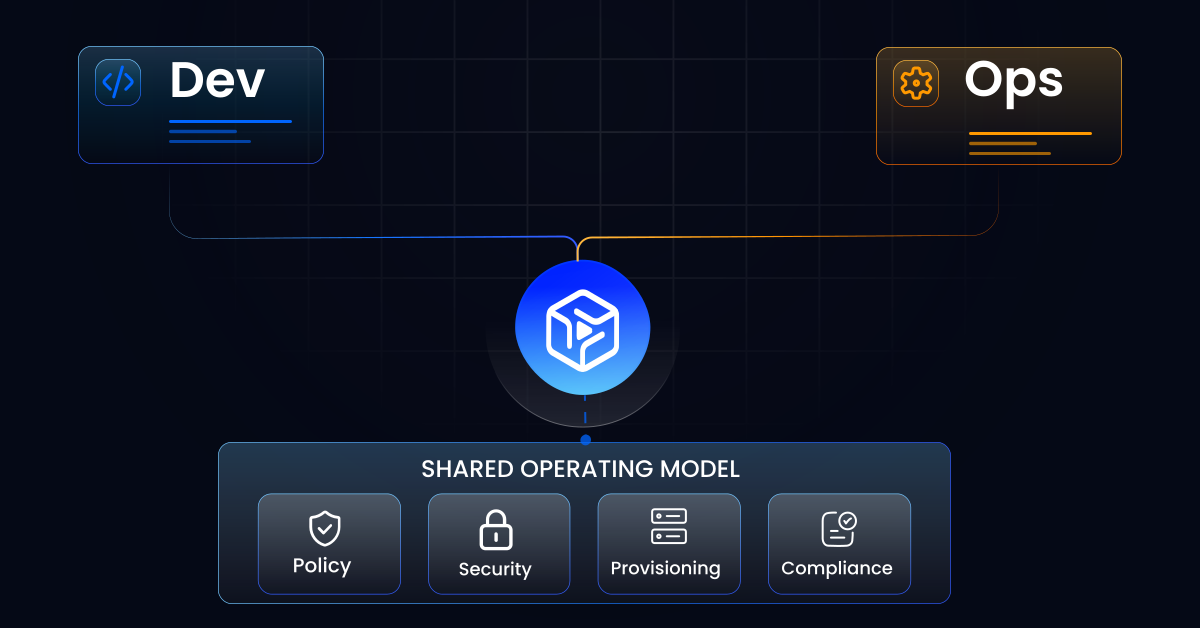
Diagram showing how a shared operating model aligns development and operations teams through Platform Engineering.

How to Align Dev and Ops Without Adding More Tools

Aligning infrastructure teams and development teams comes down, first of all, to the operating model. Tools matter, but on their own they explain little of what slows delivery down.Over the past few years almost every organization has tried to speed up delivery by adopting cloud, containers, and CI/CD pipelines. The outcome tends to repeat itself: developers want to move fast, while whoever runs the infrastructure has to guarantee security, compliance, and cost control. A structural conflict follows, where developers experience controls as a brake and Ops read team autonomy as a risk.There is a fairly precise way to measure that conflict: the cognitive load on developers, meaning how much they have to hold in their head before they can ship. When every team needs Kubernetes, Terraform, IAM policies, and the quirks of each provider, the time spent wiring infrastructure together is time taken from the product. Gartner estimates that by 2026, 80% of large software organizations will have a dedicated platform engineering team, up from 45% in 2022.The useful question, then, is how to design a system where speed and governance stop competing. It is the question Fractal Cloud was built around, and it deserves a general answer before a product one.

Platform Engineering