Fractal Sprint | Webinar: How to Build a Governed Developer Platform | Watch Now →

From Bottleneck to value multiplier: Scaling Human Expertise in the Cloud Era

Diagram illustrating how Fractal Cloud scales human expertise through automation and centralized cloud infrastructure

Introduction

A security team resolves a critical vulnerability. An architect defines a flawless resilience pattern. A database expert optimizes a complex query. In most companies, these solutions remain tacit knowledge, dispensed through manual consultations that don't scale. What if every solution could be transformed into a reusable digital asset, instantly available to the entire organization?In the age of cloud and DevOps, the "you build it, you run it" mantra has given development teams great autonomy, but it has also buried them in enormous complexity. To manage this chaos, many organizations created centralized teams of experts. Unfortunately, these teams often turned into well-intentioned but ineffective gatekeepers—bottlenecks that slow down innovation with manual reviews.This article isn't about replacing one tool with another. It's about a more profound shift: how to move beyond the gatekeeper model to transform expert teams from guardians into value catalysts, through a new socio-technical paradigm: Platform Engineering and the "Platform as a Product" concept.

The Paradigm Shift: From Gatekeeper to Value Catalyst

The traditional approach of functional teams (e.g. the ops and development departments) creates an "us vs. them" dynamic. Quality becomes a delegated task, stifling the end-to-end ownership that lies at the heart of DevOps culture.

The Rise of Platform Engineering

Platform Engineering emerges as the discipline to make DevOps scale. A dedicated Platform Team doesn't impose rules; it creates "Golden Paths"—self-service pathways that make "the right way the easy way." Their primary goal is to reduce the cognitive load on technical teams (developers and operations) by abstracting complexity and embedding best practices directly into the tools they provide.

The Core Principle: "Platform as a Product"

The most radical change is treating the internal platform as a product in its own right, with development and operations teams as its "customers." This shifts the model from push-based (imposing) to pull-based (attracting). The Platform Team must create a product so compelling that teams choose to adopt it because it simplifies their work.This approach transforms the platform from a cost center into a measurable value engine. Success is no longer measured in passed audits but by its impact on the entire organization. It's a move from a mindset of risk control to one of risk management through automation; from an interaction model based on 1-to-1 consulting to a 1-to-many self-service model; and from metrics of standard adherence to value-driven metrics like platform adoption, developer satisfaction, and improvements in DevOps Research and Assessment (abbreviated to DORA) metrics.

Fractal Architecture: The Framework to Codify and Scale Expertise

How, in practice, can a Platform Team "package" its expertise into a product? The answer is a framework that turns knowledge into digital assets: Fractal Architecture.A Fractal is a composable architectural template that codifies security, operational, and compliance best practices. Instead of dispensing knowledge through consultations, the expert team encodes it into a Fractal that can be consumed by anyone. This is the crucial shift from a 1-to-1 to a 1-to-many interaction model.

The Composition Hierarchy: Atoms, Molecules, and Fractals

The architecture organizes components into a hierarchy that abstracts complexity:🔷 Atoms: The fundamental building blocks, like a VM, a firewall rule, or an S3 bucket. They are managed by specialist teams (e.g., networking, security) and are "hardened" to be secure by default.🔷 Molecules: Compositions of Atoms representing common patterns, like a "search cluster." They are managed by enabling teams (e.g., architecture, security).🔷 Fractals: Compositions of Molecules and Atoms representing complete architectures, like a "three-tier application template." They are the main "product offerings" for technical teams.This approach enables "Governance by Design": compliance isn't checked afterward but is baked into the design of the components themselves. When a team instantiates a Fractal, the resulting system is automatically secure and compliant.

How It Works in Practice: An Automated Ecosystem

An automation engine, the Fractal Automation Engine, translates Fractal definitions into real, provisioned infrastructure. But its real power lies in ensuring continuous compliance.Using an Operator Pattern, a software agent constantly monitors the state of the infrastructure, compares it with the desired state (defined in the Fractal), and, if there's a discrepancy, acts autonomously to correct it. This continuous reconciliation loop combats "configuration drift" and ensures that governance is an automated and perpetual process, not a one-time event.

The Ops and Development Teams Experience

For technical teams, the workflow becomes incredibly streamlined:1. Discovery: they browse an internal portal and discover the available Fractals.2. Selection: they choose the Fractal that fits their needs.3. Configuration: they provide the high-level parameters required to customize the component.4. Instantiation: they request the environment's creation through the tools provided by the platform.In a matter of minutes, they get a complete, secure, and compliant environment, known as a Live System, without ever having to interact with low-level infrastructure.

A New Organizational Model

This is not just a technical transformation, but an organizational one as well. The Fractal structure maps naturally to the Team Topologies framework, defining a clear division of responsibilities:🔷 Infrastructure Specialists (Complicated Subsystem Team): Own and manage Atoms.🔷 Enabling Teams: Own and manage Molecules and Fractals.🔷 Platform Team: Owns and manages the automation engine, SDK, and portal.🔷 Development and Operations Teams (Stream-aligned Team): Are the consumers of Fractals and own their instances (Live Systems).An architecture like this promotes and enables an aligned organizational structure, but it does not impose it as a prerequisite. This doesn't mean an organization must be perfectly structured to begin. In fact, the opposite is often true. Introducing a Platform Team and starting to codify the first pieces of expertise into reusable assets is the first step in an evolution. As the platform proves its value and gains adoption, the organization can progressively align with this model, driven by the need to scale collaboration and asset management. It's an evolutionary path, not an overnight revolution.

Building the Digital Capability Factory of the Future

The shift from a central control team to a Platform Team that produces reusable digital assets is a strategic imperative. The expertise of your specialists, once encoded in a Fractal, is amplified and scaled through automation, becoming a lasting competitive advantage.To embark on this transformation, here are some strategic recommendations for technology leaders:1. Adopt a Product Mindset: Treat the internal platform as a strategic product. Hire or train dedicated product managers.2. Start with the "Thinnest Viable Platform" (TVP): Identify the biggest friction points for your development and ops teams and build one or two key Fractals to solve them. Demonstrate value quickly to build momentum.3. Structure Teams for Success: Align your organization with the Team Topologies model to support the desired architecture, not hinder it.4. Measure What Matters: Implement Developer Experience (DevEx) and DORA metrics from day one to guide the platform roadmap and demonstrate tangible ROI to the business.Ultimately, this operating model allows you to build a true "digital capability factory," where each Fractal is a pre-approved, secure, and reusable building block. This ensures that innovation doesn't come at the expense of stability and security, preparing your organization to thrive in the digital age.Build Faster, Run Anywhere.

Frequently asked questions

What is Platform as a Product?

Platform as a Product is a Platform Engineering approach where the internal platform is treated as a product designed for developers and operations teams. The Platform Team continuously improves the platform based on user needs, making secure, compliant, and reusable infrastructure the easiest option to adopt.

What are Golden Paths in Platform Engineering?

A Golden Path is a pre-approved route to a common outcome: deploy a web application, add a database, create a test environment. The Platform Team builds and maintains it, the security and compliance decisions are already inside it, and it is the fastest option available. That last part is what makes it work. Governance holds because the compliant route is also the route of least resistance, not because the alternatives are forbidden.

How does Platform Engineering reduce developer cognitive load?

Cognitive load here means the number of things a developer has to keep in mind that have nothing to do with the feature they are building: which network setup this cloud expects, which IAM permission the service needs, which security policy applies in production. Platform Engineering moves those decisions into reusable platform capabilities where they have already been made once. The developer asks for a database and gets one that is encrypted, backed up and monitored, without learning how each provider configures it.

More articles

The metric CTOs never look at: the average age of infrastructure debt

The metric CTOs never look at: the average age of infrastructure debt

A CTO watches uptime, team velocity, and the monthly cloud bill. Those three are easy to watch: they update themselves, they have dashboards, and they compare month over month without anyone building anything.Now try to answer a different question from those same three dashboards. For each production environment, how long has it been since it last matched the definition it was built from? Uptime cannot tell you. Velocity measures the code your teams ship, not the infrastructure they stopped touching. The bill goes up when things are neglected, not down, so it does not even point in the right direction.That question has a measurable answer, and almost nobody measures it.

Day 2 Operations
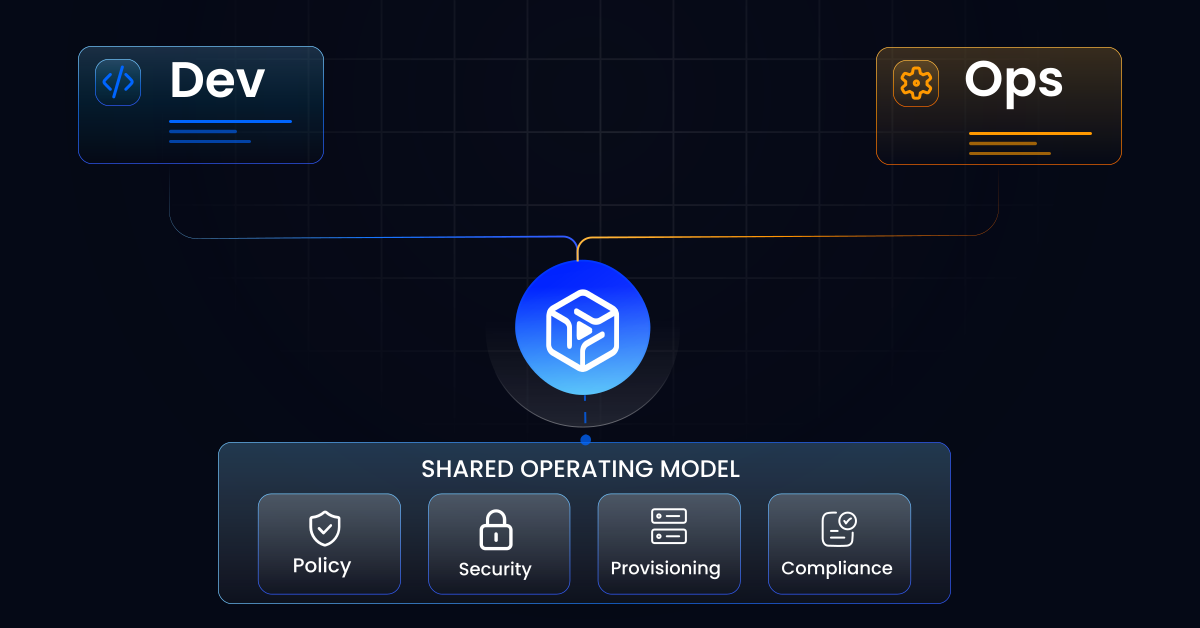
Diagram showing how a shared operating model aligns development and operations teams through Platform Engineering.

How to Align Dev and Ops Without Adding More Tools

Aligning infrastructure teams and development teams comes down, first of all, to the operating model. Tools matter, but on their own they explain little of what slows delivery down.Over the past few years almost every organization has tried to speed up delivery by adopting cloud, containers, and CI/CD pipelines. The outcome tends to repeat itself: developers want to move fast, while whoever runs the infrastructure has to guarantee security, compliance, and cost control. A structural conflict follows, where developers experience controls as a brake and Ops read team autonomy as a risk.There is a fairly precise way to measure that conflict: the cognitive load on developers, meaning how much they have to hold in their head before they can ship. When every team needs Kubernetes, Terraform, IAM policies, and the quirks of each provider, the time spent wiring infrastructure together is time taken from the product. Gartner estimates that by 2026, 80% of large software organizations will have a dedicated platform engineering team, up from 45% in 2022.The useful question, then, is how to design a system where speed and governance stop competing. It is the question Fractal Cloud was built around, and it deserves a general answer before a product one.

Platform Engineering
Why Great Observability Still Wakes You Up at 3 AM

Why Great Observability Still Wakes You Up at 3 AM

Closing the Loop Between Observability and InfrastructureMost organizations have good observability. They know within seconds when something breaks. And then someone gets paged.Alerts fire into runbooks, runbooks require humans, and humans are a bottleneck. The industry spent a decade solving the seeing problem. The acting problem is still largely manual.According to ITIC 2024 analysis, every minute of downtime costs a data center an average of $9,000. Speed and precision of response are not an operational detail: they are the factor that determines the final cost.There are two reasons this persists: operational data is fragmented across tool silos, so no single system has the full picture; and organizations don't trust automation they can't explain. Both problems need the same fix: a layer that contextualizes events across the full system, reasons deterministically about what to do, and executes infrastructure changes with full traceability.

Day 2 Operations