Fractal Sprint | Webinar: How to Build a Governed Developer Platform | Watch Now →

Blog

Notes on the agentic platform, governance and sovereignty, plus stories from the customers and partners we work with.

Simplifying NIS2 compliance in multi-cloud environments through standardized infrastructure and automation

NIS2 and Cloud: How to Stay Compliant Without Slowing Delivery

🔹 Executive takeawayNIS2 compliance is a matter of operational scale, not just regulation.Manual approaches are not sustainable in multi-cloud environments.Standardizing infrastructure is the most effective way to reduce risk and complexity.Embedding compliance into the platform allows you to accelerate without losing control.The NIS2 directive introduces new cybersecurity requirements for European organizations.The problem in 2026 is not understanding them.It’s implementing them in complex cloud environments without increasing operational complexity or slowing down development.Fractal Cloud addresses this challenge by integrating security, governance, and automation directly into the infrastructure.

Governance
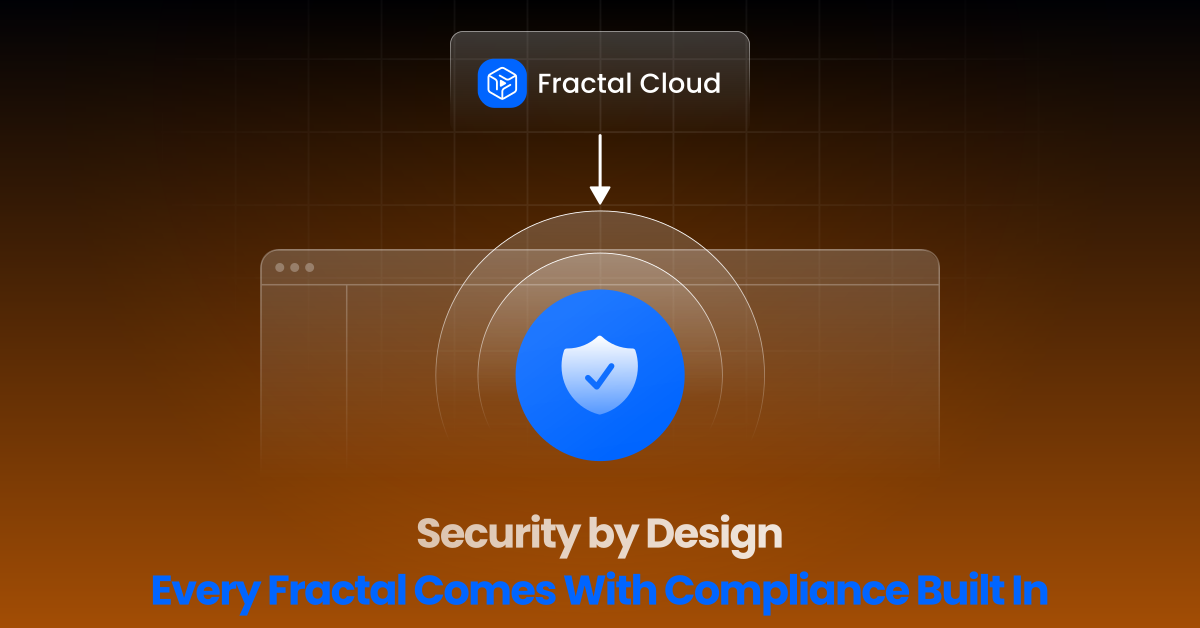
Fractal Cloud Security by Design with built-in compliance in every Fractal

Security by Design: Why Compliance Reviews Keep Failing

There's a pattern in engineering organizations that have grown fast. Security works like this: developers provision infrastructure, then a security review happens, then issues get filed, then someone fixes them, then another review. The loop takes days. Sometimes weeks.This isn't security. It's security theater with a delayed blast radius.The deeper problem: when security lives in the process around infrastructure, it can't keep pace with the infrastructure itself. Every new team, every new cloud account, every new environment is another opportunity for the process to break down.This post is for platform teams and DevOps engineers who are tired of security being a bottleneck rather than a baseline. We'll cover why bolt-on security doesn't scale, what "security by design" means at the infrastructure level, and how Fractal Cloud implements it.

Governance
Architecture diagram showing Fractal Cloud enabling cloud sovereignty by controlling data, applications, and operational processes without vendor dependency

Cloud Sovereignty: Why "Partly Sovereign" Does Not Exist

In the debate over IT modernization, a comfortable yet dangerous narrative has taken hold: the idea that cloud sovereignty is a spectrum, a scale of greys where "a little compliance" is still a step in the right direction.

Governance
Fractal Cloud architecture illustrating unified automation and operational governance

Overcoming Operational Complexity: How Fractal Cloud Unifies Automation, Compliance, and Governance.

In the modern DevOps cycle, and with the rising adoption of Platform Engineering, many teams operate with distributed tools that separately handle provisioning, configuration, monitoring, and compliance. This approach increases dependence on cloud specialists and makes it difficult to maintain consistency across environments.With Fractal Cloud, these activities are integrated into a single Internal Developer Platform (IDP). Governance, security, and automation are embedded into versioned and reusable components called Fractals, which include technical blueprints, policies, and managed operations.

Governance