Fractal Sprint | Webinar: How to Build a Governed Developer Platform | Watch Now →

Blog

Notes on the agentic platform, governance and sovereignty, plus stories from the customers and partners we work with.

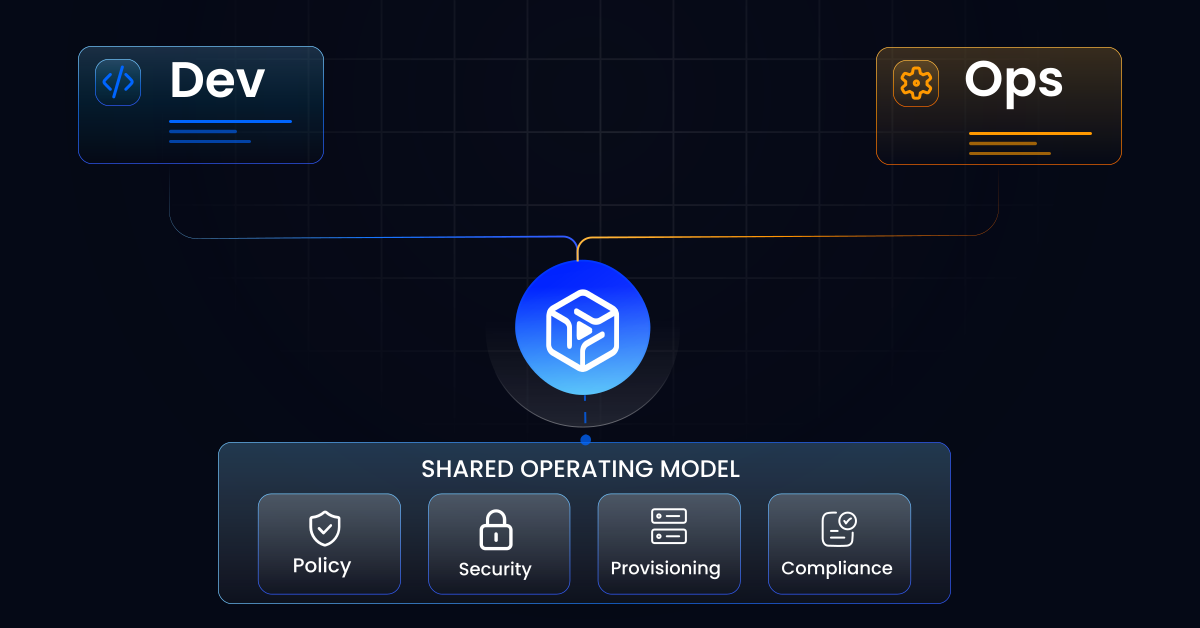
Diagram showing how a shared operating model aligns development and operations teams through Platform Engineering.

How to Align Dev and Ops Without Adding More Tools

Aligning infrastructure teams and development teams comes down, first of all, to the operating model. Tools matter, but on their own they explain little of what slows delivery down.Over the past few years almost every organization has tried to speed up delivery by adopting cloud, containers, and CI/CD pipelines. The outcome tends to repeat itself: developers want to move fast, while whoever runs the infrastructure has to guarantee security, compliance, and cost control. A structural conflict follows, where developers experience controls as a brake and Ops read team autonomy as a risk.There is a fairly precise way to measure that conflict: the cognitive load on developers, meaning how much they have to hold in their head before they can ship. When every team needs Kubernetes, Terraform, IAM policies, and the quirks of each provider, the time spent wiring infrastructure together is time taken from the product. Gartner estimates that by 2026, 80% of large software organizations will have a dedicated platform engineering team, up from 45% in 2022.The useful question, then, is how to design a system where speed and governance stop competing. It is the question Fractal Cloud was built around, and it deserves a general answer before a product one.
Platform Engineering
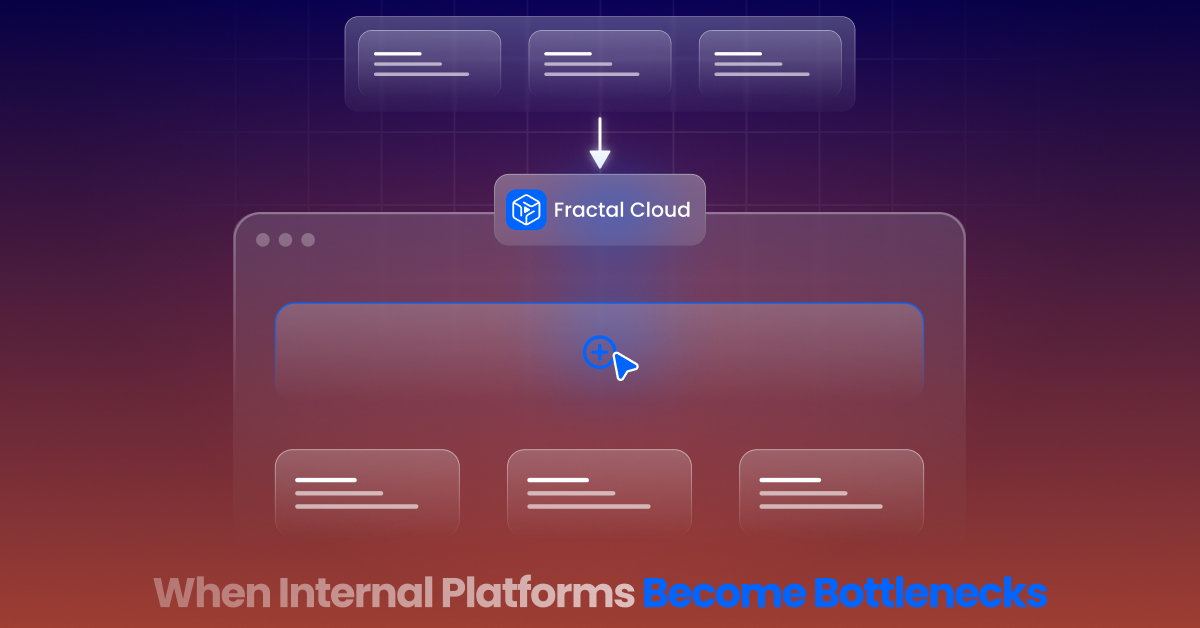
Illustration of Fractal Cloud orchestrating infrastructure components, highlighting how internal platforms can become bottlenecks

When Internal Platforms Become Bottlenecks

Over the last decade, many organizations have embraced Platform Engineering as a way to accelerate software delivery.The promise is compelling: build an internal platform that provides developers with standardized tools, infrastructure, and automation so they can focus on building applications instead of managing environments.In theory, this should increase productivity, improve governance, and reduce operational overhead.In practice, things are often more complicated.

Platform Engineering
Developer Portal vs Platform: Why a Portal Is Not Enough

Developer Portal vs Platform: Why a Portal Is Not Enough

Looking back at 2024, we remember the obsession with "UI-first thinking." At the time, many companies fell into the trap of confusing the interface with the platform, spending months implementing developer portals (like Backstage) without first resolving the underlying fragmentation.It is precisely to overcome this confusion between interface and platform that solutions like Fractal Cloud are born as a control plane first, rather than just a visible product. Today, in 2026, we know that the portal is just a view, not the substance.Platform Engineering has matured, transforming from the management of integrated toolchains into a product discipline. The Internal Platform is no longer an agglomeration of scripts and services, but a proper product with a roadmap, stable APIs, clear ownership, and a governed lifecycle.In Fractal Cloud, the platform is a governed product: every exposed capability is deliberately limited, versioned, and traceable.The driver for this evolution was the need to manage a level of complexity that is no longer compressible by humans alone. Between provider fragmentation, AI costs, and supply chain security, the cognitive load on the individual developer became unsustainable. In 2026, the Platform does not serve to "facilitate" via graphical interfaces; it serves to ensure determinism.Here is how the discipline has evolved and why the Internal Developer Platform (IDP) of the future is, first and foremost, an operating model.

Platform Engineering
Diagram illustrating how Fractal Cloud scales human expertise through automation and centralized cloud infrastructure

From Bottleneck to value multiplier: Scaling Human Expertise in the Cloud Era

A security team resolves a critical vulnerability. An architect defines a flawless resilience pattern. A database expert optimizes a complex query. In most companies, these solutions remain tacit knowledge, dispensed through manual consultations that don't scale. What if every solution could be transformed into a reusable digital asset, instantly available to the entire organization?In the age of cloud and DevOps, the "you build it, you run it" mantra has given development teams great autonomy, but it has also buried them in enormous complexity. To manage this chaos, many organizations created centralized teams of experts. Unfortunately, these teams often turned into well-intentioned but ineffective gatekeepers—bottlenecks that slow down innovation with manual reviews.This article isn't about replacing one tool with another. It's about a more profound shift: how to move beyond the gatekeeper model to transform expert teams from guardians into value catalysts, through a new socio-technical paradigm: Platform Engineering and the "Platform as a Product" concept.

Platform Engineering